What Are AEO and SEO? A Quick Definition
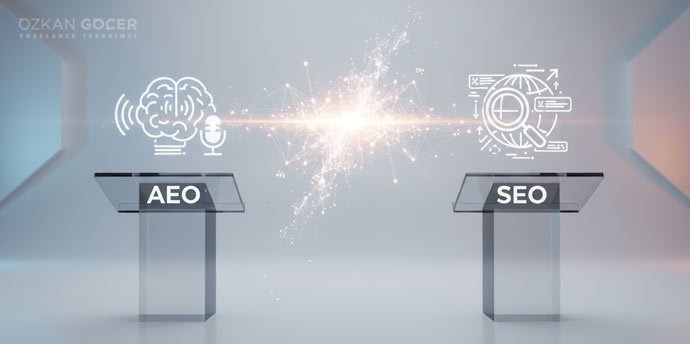
Let us start by separating the two clearly. SEO (Search Engine Optimization) is the practice of optimizing your content to rank near the top of classic search engines like Google; the goal is to stand out among the blue links the user clicks. AEO (Answer Engine Optimization) is optimizing your content so it is shown as a source in the answers produced by AI answer engines like ChatGPT, Perplexity, and Google AI Overview. I explain the basics of AEO in detail in my what is AEO article.
The Core Difference: Ranking or Answer?
The most basic difference is the targeted output: SEO chases a ranking, AEO chases an answer. In SEO, success is appearing at the top of the results page and earning clicks. In AEO, success is appearing inside the AI text that answers the user's question and among the cited sources; on citation-focused engines like Perplexity, you often gain visibility without a single click. As user behavior changes, "ranking at the top" alone is no longer enough; I cover how AI is changing search in my AI and SEO article.
AEO vs SEO Comparison Table
Let us put the two approaches side by side on the core criteria:
Scroll sideways to read every column. Keyboard: focus the table and use the arrow keys.
| Criterion | SEO | AEO |
|---|---|---|
| Goal | Blue-link ranking | Being a source in the AI answer |
| Platform | Google, Bing search | ChatGPT, Perplexity, AI Overview |
| Success metric | Position, clicks, traffic | Citations, visibility |
| Content focus | Keyword and intent | Clear answer, structure, sources |
| Click | Required | Often click-free |
The table sums it up: the two target different outputs but draw on the same quality-content foundation.
Where Does GEO Fit?
There is also GEO (Generative Engine Optimization); it focuses on visibility in generative AI engines and in practice means largely the same thing as AEO. Some experts use GEO more broadly (all generative engines) and AEO as "answer"-focused; but in everyday language the two are often used interchangeably. What matters is not the terminology debate but the principle: producing clear, credible content that AI can understand and cite. You can follow industry updates from authoritative news sources.
Shared Foundation: Both Rise on the Same Ground
The good news is that AEO and SEO are complementary, not rivals. Both rise on the same solid ground: a crawlable and indexable site, strong E-E-A-T (experience, expertise, authoritativeness, trust), quality and original content, speed, and mobile-friendliness. AI answer engines also often crawl the same web and look at the same authority signals; building the technical base to Google Search Central standards benefits both. So well-done SEO already handles half of AEO; you can find the logic of the search algorithm in my Google algorithm article.
Which Should You Prioritize?
Which to prioritize depends on your audience and industry. In many areas where demand is still largely in classic search, SEO remains the priority; but in information-heavy areas with many "how" and "what" questions, AI answers are rapidly taking share and AEO becomes critical. The right approach is not to see the two as separate projects but to plan them as two outputs of a single content strategy. I gathered how to structure content for AI in my content optimization for AEO article.
Using the Two Together in 2026
In 2026, the winning strategy is building SEO and AEO together. In practice, that means writing every piece to answer both search intent and a direct question, using a question-and-answer structure and structured data (schema.org), showing sources and recency, and keeping the technical base strong. Content built this way ranks high in blue links and gets cited in AI answers. I explain visibility in AI search step by step in a separate article; for a professional AEO and SEO strategy, you can take a look at my AEO consulting service.