
A screen showing 5% leaves several questions unanswered. Which asset pays the reward? Who controls withdrawals? When you leave, will you wait for the underlying asset or sell a different token?
Checked on October 20, 2026. Network details come from official documentation. The calculations are hypothetical; no deposit, staking transaction or investment return was tested.
What Is Staking, and Where Do Rewards Come From?
On Proof of Stake networks, validators propose and validate blocks under the network’s rules. Participation can earn protocol rewards; their source and distribution vary by chain. Simply keeping a coin in a wallet does not necessarily mean it is being staked.
Ethereum’s staking overview describes depositing ETH to activate a validator. Other networks let holders delegate their stake weight to a pool. Treat “staking” as a starting point for checking the mechanism, rather than a universal instruction to lock funds.
Staking, Mining, Lending and Earn
Bitcoin uses Proof of Work mining. Its own consensus system does not pay ETH-style PoS staking rewards. A product marketed as “BTC staking” may involve another protocol, custody arrangement or yield mechanism. The name alone does not establish participation in Bitcoin mining.
Lending involves making assets available to borrowers. For example, supplying tokens to Aave puts them into a lending liquidity pool. Yield farming can involve other incentives and liquidity strategies. Finding all these products under an Earn menu does not make them equivalent to network staking. Identify the source of the payment.
How to Stake Crypto: Separate the Methods First
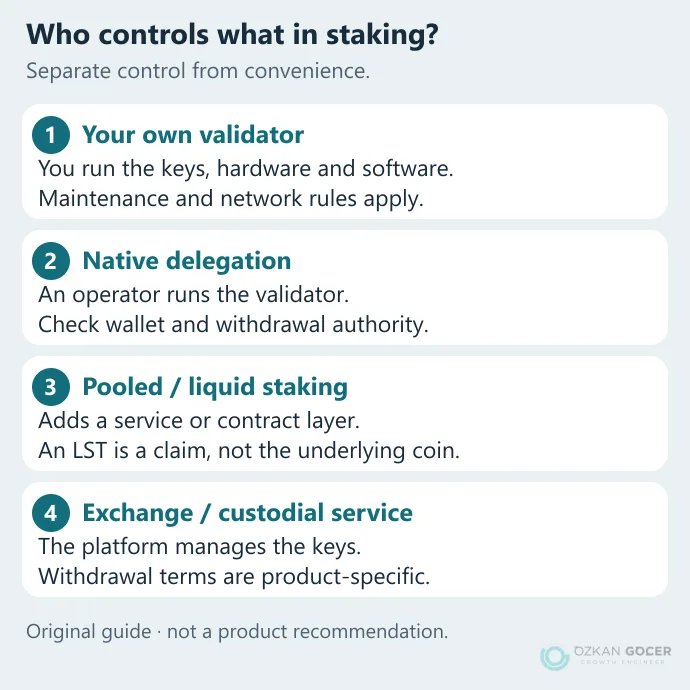
Before looking for a button, work out who controls the assets and who runs the infrastructure. These four routes assign different responsibilities.
Scroll sideways to read every column. Keyboard: focus the table and use the arrow keys.
| Method | What You Manage | What Else to Check |
|---|---|---|
| Your own validator | Keys, software and hardware operation | Maintenance, network penalties and exit rules |
| Native network delegation | Your wallet and delegation choice; verify withdrawal authority separately | Validator performance, commission and network delays |
| Pooled / liquid staking | A pool interest or staking token, depending on the product | Contracts, operators, governance and the token’s market |
| Exchange / custodial service | Your platform account and service instructions | The key-holding entity, product agreement and withdrawal terms |
Ethereum requires at least 32 ETH to activate your own validator, along with maintaining node software and connectivity. Pools can accommodate smaller amounts, but introduce additional service or contract dependencies. A network’s minimum and a platform’s product limit are separate figures.
With an exchange, identify the entity behind your account and the exact product, not just the brand. Our guide to assessing exchange custody and withdrawal arrangements covers that separate decision. Inclusion in a comparison does not establish protection for a staking product.
Why ETH, SOL and ADA Have Different Rules
One lock-up period or slashing rule cannot describe every network. Three examples show why the chain and product both matter.
- Ethereum: being offline can mean missed rewards and penalties. Slashable violations, such as signing conflicting blocks, are a separate, more serious category. The Ethereum penalty documentation distinguishes them; an ordinary connection outage is not automatically slashing.
- Solana: native delegation uses a separate stake account. The current Solana documentation states that slashing is not implemented in the protocol. That does not rule out losses from price changes or a service you use.
- Cardano: natively delegated ADA remains spendable. Poor pool performance can reduce rewards, but does not slash the delegator’s principal. These are properties of Cardano’s native delegation model, not automatic promises about an exchange’s ADA product.
“I hold the keys” also needs detail. On Solana, staking authority and withdrawal authority can differ. Check the stake account’s authorities; an app displaying a balance does not, by itself, establish your right to withdraw it.
How to Calculate Staking Rewards
Calculate the token reward first, then its cash value. APR expresses an annual rate without compounding; APY includes specified reinvestment assumptions. Also check whether a displayed figure annualizes past results or forecasts future rewards. For example, Lido’s displayed APR uses a seven-day moving average. It is not a promise about the following year.
A Worked Example with 1,000 Tokens
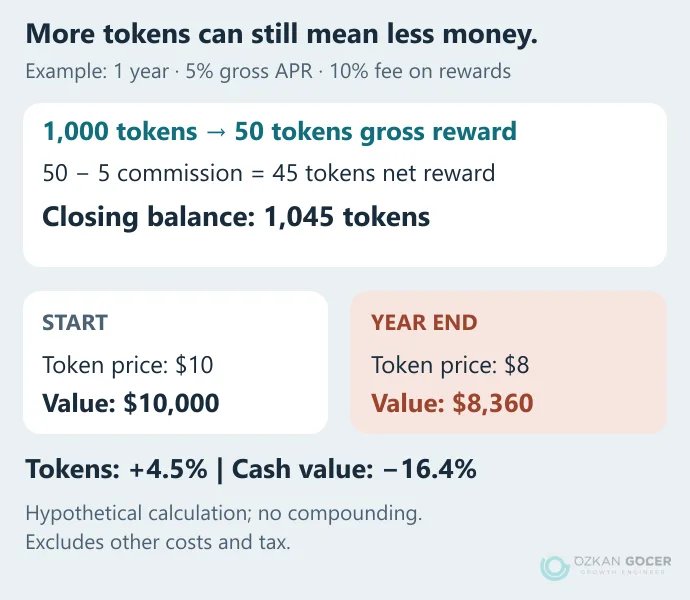
Assume a constant 5% gross APR for one year, no reinvestment, and a commission of 10% of rewards. These figures are illustrative, not a platform quote.
- Gross reward: 1,000 × 0.05 = 50 tokens.
- Commission: 50 × 0.10 = 5 tokens. You do not subtract ten percentage points from 5%.
- Reward after commission, before other costs: 50 − 5 = 45 tokens.
- Closing balance: 1,000 + 45 = 1,045 tokens.
If the price falls from $10 to $8, the starting $10,000 becomes $8,360. The token balance rose by 4.5%, but the cash-value result is −16.4% before other costs and tax. Holding the same tokens without staking would have ended at $8,000. That separates the $360 added by staking from the overall investment outcome.
For a shorter period, a simple estimate is amount × annual APR × days / 365. Account separately for days before rewards start, commission, network charges and any service costs. Do not deduct commission again if the displayed rate already includes it. Tax treatment requires a separate assessment for your jurisdiction and transaction.
If rewards really are reinvested monthly and the net nominal annual rate stays at 4.5%, APY = (1 + 0.045 / 12)^12 − 1 gives approximately 4.59%. Changing rates or reinvestment costs break those assumptions. Token supply growth is another consideration; subtracting it from the reward rate does not, by itself, calculate your dollar return.
How Do You Get Staked Crypto Back?
Submitting an exit request is different from having spendable funds. Also distinguish withdrawing a token from receiving cash: unstaking is not a transfer to your bank account.
A full Ethereum validator exit goes through network exit and withdrawal processing. Withdrawing rewards and exiting the entire balance are different operations; the validator type also affects automatic reward transfers or compounding. A pool or exchange may add its own processing time.
Native Solana stake is deactivated first. The change is not immediate and completes across epoch boundaries. Cardano’s natively delegated ADA stays spendable, while withdrawing accumulated rewards has a separate governance requirement: the stake key needs active vote delegation. Besides choosing a DRep, abstain and no-confidence options are available.
Liquid Staking: Selling Is Different from Redeeming
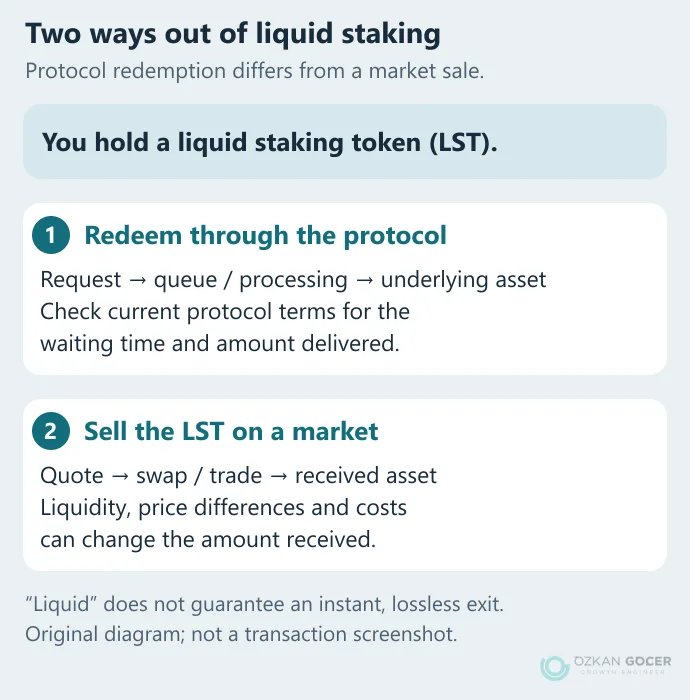
A liquid staking token, or LST, represents a claim related to staked assets. You can seek redemption through the protocol or sell the token on a market. Lido’s withdrawal explanation illustrates the distinction with stETH. Redemption can involve a queue; a market sale depends on available liquidity, price and transaction costs. “Liquid” does not guarantee an immediate exit at full underlying value.
Which Risks Can Cause Which Losses?
Scroll sideways to read every column. Keyboard: focus the table and use the arrow keys.
| Risk | Possible Effect | Information to Inspect |
|---|---|---|
| Token price | Cash value can fall despite more tokens. | Track token balance and cash value separately. |
| Network penalty / operator error | Rewards or staked balance can fall, depending on the chain. | That network’s rules and the operator’s history |
| Pool contracts / governance | Software flaws or changed terms can affect assets. | Audit date, scope, deployed version and governance powers |
| Custodian | Withdrawals can stop or access to funds can be lost. | Contracting entity, custody and withdrawal arrangements |
| LST market | The sale price can diverge from underlying value. | Executable quote, price impact and redemption alternative |
| Malicious site / wrong signature | An approval or transfer can cause asset loss. | Domain, network, address and permission being granted |
An audit does not close every risk. Lido’s own risk documentation, for example, separately discusses software, oracle and governance exposure. Using an LST as loan collateral or depositing it into another protocol adds risks beyond staking alone.
A hardware wallet helps manage keys. It does not neutralize a harmful contract you approve, network penalties or a falling token price. Read our discussion of hardware-wallet approvals and recovery with that boundary in mind.
Before You Confirm a Staking Transaction
- Identify the product: native delegation, a pool or lending? Find the explanation before proceeding if the mechanism is unclear.
- Decode the rate: note APR/APY, gross/net, reward asset, commission and the date of the figure.
- Read the exit process: distinguish request, waiting and delivery, plus any alternative LST sale.
- Check authority: who controls keys and withdrawals? Which asset and amount can a contract permission access?
- Keep records: track transaction IDs, principal, rewards and fees separately. A confirmation screen alone does not establish completion onchain.
Do not give recovery words to a staking website or support agent. Ethereum’s security guidance addresses key sharing and unlimited contract permissions. If you cannot tell what a signature authorizes, stop and resolve that uncertainty first.
Staking is not automatically worthwhile just because you already own a token. Consider the mechanism, access conditions and possible losses together. The explanations and arithmetic here are educational, not recommendations for a coin, platform or investment amount.