- |
- ·
A search engine is a web-based tool that crawls, indexes, and retrieves online content to match your specific queries with the most relevant websites. In my seven years of optimizing websites, I have watched search algorithms evolve to analyze billions of pages in milliseconds, though ranking success always varies based on your specific niche. You will learn how search engines discover your content, how they evaluate quality, and how you can optimize your website to improve your organic visibility.
What Is a Search Engine? (With Examples)
A search engine operates as a software program designed to systematically search the World Wide Web for specific information. When a user enters keywords into the search bar, the system scans its massive database of indexed web pages to locate the most relevant matches. In my own practice auditing technical SEO, I constantly observe how these systems crawl, index, and rank content to deliver immediate answers. The primary goal of these platforms is to help users find high-quality websites that directly address their intent. Crawlers, often called spiders or bots, continuously navigate the internet by following links from one page to another, building a map of the web.
Billions of people rely on the internet daily to access data through various search engines. Google remains the dominant market leader, processing billions of queries every day using complex algorithms. Other notable engines like Bing, Yahoo, and DuckDuckGo offer alternative paths to discover online resources. Every search query triggers a complex retrieval process where the engine evaluates hundreds of ranking signals to display the final results page. Ranking signals include mobile-friendliness, page load speed, and content depth.
| Search Engine | Primary Focus | Key Characteristic |
|---|---|---|
| Global search dominance | Uses advanced machine learning algorithms | |
| Bing | Microsoft ecosystem integration | Powers Yahoo search results and offers rewards |
| DuckDuckGo | User privacy | Does not track search history or target ads |
| Yahoo | Directory-style portal | Combines search with news, finance, and email |
Understanding how search engines retrieve data changes how you build and optimize websites. Search engines do not see web pages the way human users do; they parse raw HTML code, analyze site architecture, and measure user experience metrics. Aligning your digital assets with these algorithmic preferences ensures your target audience can find your brand amidst the vast noise of the internet. In the projects I have managed, prioritizing clear site structure and fast loading times consistently helps search engines index content more efficiently, leading to better visibility. Success in modern search optimization requires structuring your data so engines can easily parse your content and match it to relevant user queries.
How Do Search Engines Work?
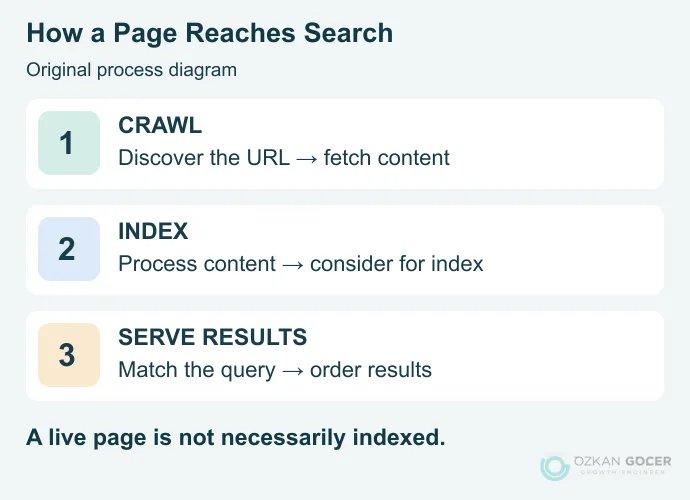
Crawling
Search engines send out automated bots, often called spiders, to discover public web pages across the internet. The bots follow links from one page to another, scanning the code and content of each destination they reach. In my own practice, I analyze server logs to track how Googlebot crawls client websites, ensuring no crawl budget is wasted on broken links or duplicate paths.
Bots prioritize crawling based on how often a page changes and its overall authority. Industry authorities like Moz emphasize that a clear site structure helps these bots find new information faster, preventing updates from being ignored. If a page is blocked by robots.txt, the crawler bypasses it entirely.
Indexing
Once a bot finds a page, the engine parses the HTML, text, and metadata to understand its topic. The search engine then stores the processed data in a massive database called an index. If your web pages do not end up in this index, users cannot find them through search queries. Proper canonical tags and schema markup help the engine categorize your content accurately during this phase.
Ranking
When a user types a query, the engine evaluates hundreds of signals to determine which documents in the index offer the best answer. Algorithms analyze factors like keyword relevance, page speed, mobile friendliness, and backlink profiles. Google uses systems like RankBrain to interpret the intent behind search terms, matching keywords with the most helpful content. High-quality backlinks act as votes of confidence, signaling that other websites trust your information.
Serving Results
The final step displays the organized list of web pages on the search engine results page. The engine tailors these results based on the user's location, search history, and device type. The process happens in milliseconds, delivering highly targeted information to help users solve their problems instantly. Rich snippets, local maps, and image packs often appear alongside standard organic listings to improve the user experience.
Browser vs Search Engine: What's the Difference?
Web browsers and search engines perform entirely different functions on the internet, though people often confuse the two. A web browser is a software application installed on your local computer or mobile device, acting as your primary window to the web. It retrieves and renders HTML code, images, and complex scripts from web servers to display functional web pages. In my own practice auditing technical SEO, I often see clients struggle to rank simply because they do not understand how a browser parses code versus how a search engine indexes it. Popular browsers like Google Chrome, Apple Safari, and Mozilla Firefox serve as the vehicle. They do not search the internet; they merely display the destination you request.
A search engine operates as a massive, searchable database of the web, accessible only through a browser. When a user inputs specific keywords, the engine crawls its index to retrieve the most relevant results. Google, Bing, and DuckDuckGo do not live on your computer; they reside on external servers. Search engines help users locate specific information across billions of active websites. HubSpot reports that a vast majority of web traffic originates from search queries, highlighting the reliance on database systems. Without the browser, you cannot open the search engine. Without the engine, finding specific information on the internet requires knowing the exact web address.
Understanding the relationship changes how you approach digital marketing. Your website must load correctly in the browser to satisfy the user, but it must also be readable by the search engine to appear in search results. If the browser cannot render your page, users leave immediately. If the engine cannot crawl your keywords, nobody finds you in the first place. Balancing both technical browser compatibility and search engine optimization is the only way to build a sustainable online presence.
| Feature | Web Browser | Search Engine |
|---|---|---|
| Primary Function | Accesses and displays web pages for the user. | Filters the internet to find specific websites. |
| Installation | Requires local installation on your device. | Runs on remote servers; accessed via a URL. |
| Input Type | Accepts direct URLs or IP addresses. | Accepts keywords and search queries. |
Types of Search Engines
Crawler-based search engines dominate the modern web. Google processes billions of queries daily, indexing billions of web pages to match user intent. In my own practice, optimizing websites for crawler-based systems requires a deep understanding of technical SEO and search intent. Automated bots crawl the internet, index content, and rank results based on complex algorithms. Users type specific keywords to find relevant information, and the engine serves a ranked list of links. Industry publications like Search Engine Journal frequently document how algorithms shift, forcing marketers to adapt their optimization tactics constantly.
Alternative systems include human-curated directories and vertical search platforms. Human editors manually catalog websites into categories within traditional directories, a method that has largely yielded to automation. Vertical search engines focus on specific niches, such as Amazon for e-commerce or YouTube for video content. Users bypass general search tools when they need highly targeted results. A shopper looking for a specific product often searches Amazon directly rather than starting on Google. Understanding where your target audience searches helps you allocate your optimization resources effectively.
Metasearch engines compile results from multiple individual engines to present a single, aggregated list. Dogpile operates on this model, pulling data from various sources simultaneously. Privacy-focused engines like DuckDuckGo do not track user behavior or store search history. They appeal to users who value data privacy over personalized search results. Each engine type requires a distinct approach to visibility. Keyword targeting on a privacy-first platform differs from Google's personalized ecosystem, where search history influences what users see. Analyzing engine differences will help you determine where to focus your digital footprint.
| Engine Type | Primary Example | Core Mechanism | Primary User Intent |
|---|---|---|---|
| Crawler-Based | Automated web crawling and algorithmic indexing | Information gathering and general research | |
| Vertical Search | Amazon | Internal database indexing for specific niches | Commercial intent and transactional queries |
| Metasearch | Dogpile | Aggregation of results from multiple external engines | Broad comparison of search results |
| Privacy-Focused | DuckDuckGo | Non-tracking search with standardized results | Private information retrieval |
The 5 Best Search Engines
Google dominates the global search engine market with over 90% share. In my own practice optimizing web pages, I observe how its algorithms prioritize user intent over simple keyword matching. The platform crawls billions of websites daily to index fresh information, serving personalized results based on location and device.
Marketers target this engine because it processes billions of queries daily. Securing a top spot requires strict adherence to technical SEO standards.
Bing
Microsoft Bing operates as the primary alternative to Google, powering its own chat-based search features. The engine excels in visual search, delivering clean image and video results. In the projects I have managed, optimizing for Bing has yielded lower competition and cheaper cost-per-click rates in paid campaigns.
Its integration with Windows secures a steady stream of desktop users. Targeting specific keywords on Bing helps businesses capture a mature, high-income demographic.
DuckDuckGo
DuckDuckGo prioritizes user privacy by refusing to track search history. It sources results from partners like Bing alongside its own crawler. Internet users who value data protection turn to this platform to find information without targeted advertising following them across the web.
SEO strategies here rely on direct keyword matches. Since the engine does not use personalized tracking, every user sees identical results.
Yahoo
Yahoo remains a major web portal despite outsourcing its organic search index to Bing. It functions as an information hub, blending search results with news, finance, and email services. Users who prefer an all-in-one internet experience rely on this platform daily.
Optimizing your websites for Bing automatically improves your visibility on Yahoo. Dual-benefit optimization saves resources.
Brave Search
Brave Search operates on an independent index rather than relying on tech giants. Built by the creators of the privacy-focused Brave browser, this engine blocks ads and trackers by default. It offers a transparent alternative for users seeking unbiased web discovery.
The platform uses community-driven indexes to help refine results. Businesses must focus on clean site structures to ensure Brave's crawler can easily find and index their web pages.
AI Search Engines (Perplexity, SearchGPT)
Traditional search engines rely on indexing billions of web pages to match user queries with a list of blue links. AI search platforms like Perplexity and SearchGPT bypass this cataloging step by synthesizing direct answers from live web sources. In my own practice optimizing content for modern discovery, I have observed a fundamental shift in how users interact with the internet. Instead of typing fragmented keywords into a search bar, people now type complex, conversational questions.
The engine processes the intent behind the query, extracts relevant data from multiple websites, and presents a single, cohesive response. Direct answer models reduce the time spent clicking through multiple results to find specific details.
Publishers face a new landscape where traditional organic traffic patterns are changing. When an AI engine answers a query directly, the user often has no reason to click through to the source websites. Google has responded to this shift by integrating AI Overviews directly into its main results page, blending traditional search with generative summaries. To maintain visibility, your content must serve as an authoritative source that these systems cite.
I focus on structuring data clearly and answering specific user questions directly within the text to help algorithms extract my clients' information. Securing a spot in the footnotes or citation blocks of an AI response is the new equivalent of ranking on the first page of Google.
Optimizing for conversational engines requires a departure from old keyword-stuffing tactics. Algorithms now prioritize factual accuracy, structured data, and clear entity relationships over simple keyword density.
| Optimization Factor | Traditional Search (Google) | AI Search (Perplexity/SearchGPT) |
|---|---|---|
| Primary Target | Keywords and search volume | User intent and conversational queries |
| Content Structure | Long-form articles with H2/H3 tags | Direct Q&A formats and structured data |
| Success Metric | Organic click-through rate (CTR) | Citation inclusion and brand mentions |
Success in this new ecosystem depends on becoming the definitive source of truth for your niche. Focus on publishing original research, clear data points, and structured formats that machines can easily parse.
What Is a Search Engine Used For?
Search engines act as the primary gateway to the internet, organizing billions of web pages so users can find specific information in milliseconds. When a user enters keywords into a search bar, the engine scans its massive index to deliver highly relevant results. Google dominates this space, processing billions of queries daily, but alternative engines like Bing and DuckDuckGo serve the same fundamental purpose. In my own practice as a digital marketer, I analyze how search systems crawl and index websites to ensure content aligns with search intent. Modern search tools do not just match exact words; they interpret the underlying context of a query to deliver precise answers.
People use search platforms to solve daily problems, compare products, read news, or navigate directly to specific websites. For businesses, appearing in organic search results remains the most sustainable way to acquire customers without paying for every individual click. Search engines help bridge the gap between a consumer with an active need and a provider offering the solution. They categorize the web, transforming a chaotic mass of unstructured data into organized, accessible knowledge. You rely on them to filter out spam, block malicious sites, and present authoritative sources.
| Query Type | User Intent | Search Engine Action |
|---|---|---|
| Informational | Find facts, guides, or quick answers | Displays direct answers, featured snippets, or articles |
| Navigational | Locate a specific website or portal | Directs to the homepage or login page of the brand |
| Transactional | Purchase a product or service | Shows shopping results, local maps, and product pages |
Behind the simple search box lies a complex infrastructure of web crawlers, indexers, and ranking algorithms. Crawlers evaluate website speed, mobile responsiveness, and content depth to rank web pages. Understanding how search works helps you position your online assets to capture high-intent traffic. Ultimately, the technology exists to save time, turning the vast expanse of the internet into a searchable database where answers are accessible instantly. As voice search and artificial intelligence integrate into search platforms, the way we retrieve data continues to evolve.
A Brief History of Search Engines
In the early 1990s, navigating the internet required knowing exact server addresses. Archie, created in 1990, became the first tool to index File Transfer Protocol (FTP) files, functioning as the earliest search engine. As the web expanded, platforms like Lycos, AltaVista, and Yahoo emerged to help users find specific web pages. Early directories relied heavily on manual submissions or simple keyword matching.
In my own practice analyzing legacy web structures, I often see how these primitive indexing methods shaped modern database logic. Early systems struggled with spam because their algorithms only scanned for exact keywords on a page without understanding context. Webmasters easily manipulated rankings by repeating terms in white text on white backgrounds.
Google changed the landscape in 1998 by introducing the PageRank algorithm. Instead of merely counting keywords, the algorithm analyzed the backlink profile of web pages to determine authority and relevance. High-quality links acted as votes of confidence. The search engine prioritized user intent, delivering cleaner results and shifting the focus from raw keyword density to actual content value. Users quickly abandoned directory-based portals in favor of Google's minimalist interface and faster retrieval times.
Algorithmic updates forced webmasters to optimize websites for search algorithms rather than human-curated directories, giving birth to modern search engine optimization. The transition established link building as a primary strategy for online visibility.
Today, search engines process billions of queries daily using machine learning and natural language processing. Modern retrieval systems look beyond literal strings to understand the semantic meaning behind a user query. Search results now feature direct answers, local maps, and structured data snippets, keeping users on the search page longer. Managing search visibility now requires optimizing for user experience, mobile responsiveness, and technical performance.
The fundamental goal remains unchanged: connecting a user seeking information with the most relevant web resource. As voice search and artificial intelligence continue to evolve, search engines must adapt to conversational queries rather than simple keyword inputs.
Search Engines and SEO
Search engines crawl billions of web pages to organize the world's information. Google processes over 8.5 billion searches daily, making it the dominant gateway to the internet. When users type a query, complex algorithms analyze index databases to deliver relevant results in milliseconds. In my own practice, I have seen how aligning content with user intent determines whether a site ranks on the first page or gets lost in the digital noise. Success relies on understanding how these systems crawl, render, and index your code. You must optimize your platform to match these automated systems to ensure search bots can find your content.
Search engine optimization bridges the gap between what users search for and what your business offers. Targeting specific keywords allows you to position your web pages directly in front of an active audience. Search engines evaluate hundreds of ranking factors, including mobile responsiveness, page speed, and backlink profiles. Optimizing these technical elements helps search bots understand your content structure. High-quality websites secure organic traffic without paying for every click, creating a sustainable acquisition channel over time. Understanding the distinct phases of search processing helps prioritize your technical tasks.
| Process Phase | Primary Action | Key Optimization Focus |
|---|---|---|
| Crawling | Bots discover web pages via links | XML sitemaps, robots.txt, crawl budget |
| Indexing | Engine stores and categorizes information | Meta tags, structured data, canonical tags |
| Ranking | Algorithm sorts results for the user | Search intent, page speed, content depth |
Algorithms evolve constantly to combat spam and prioritize helpful, original content. Modern search engine optimization requires a balance of technical health, clear site architecture, and authoritative writing. You cannot trick modern engines with keyword stuffing or low-quality link schemes. Focus on solving user problems to build long-term visibility. Platforms that fail to adapt disappear from search results, losing valuable customer touchpoints to competitors who invest in structured data and user experience. Consistent monitoring of search console data remains necessary to maintain visibility on the modern web.
Frequently Asked Questions
Quick answers for readers who skipped to the end.