What Is a Crypto Trading Bot and How Does It Work?
A crypto trading bot is software that connects to an exchange through an API and places trades automatically, following the rules you define. The point is to take emotion out of the equation; written logic runs instead of fear and greed. When the price hits your target at 3 a.m., the bot acts while you sleep.
The mechanics are simple. You set a strategy and parameters such as which coin, which price range, and what position size, then the bot watches the market and opens an order through your exchange API key when a condition is met. Your funds stay on the exchange; the bot runs with trade permission only and cannot withdraw your money. If exchanges and cryptocurrency basics are still new, build that foundation first.
Bots work best in liquid, volatile markets, so high-volume assets like Bitcoin and Ethereum are the usual choice. On a thin, low-volume coin the same bot slips, because it cannot find a counterparty. Liquidity is the bot's friend.
Bot Types: DCA, Grid, Arbitrage, and AI
The bot world rests on a few core strategies, each suited to a different market. A DCA bot (Dollar-Cost Averaging) buys in steps as the price falls, pulling your average cost down; it sits close to long-term accumulation. A grid bot buys low and sells high inside a set range, collecting small gains from a sideways, choppy market.
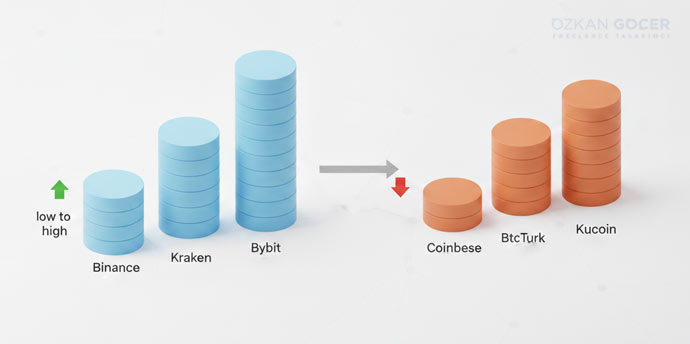
An arbitrage bot exploits the price gap for the same coin across exchanges; the gap closes fast, so speed and low fees decide the outcome. AI bots claim to generate signals through machine learning, yet the label is often marketing; if you cannot see the strategy behind it, stay cautious. Many bots pull price data from sources like CoinGecko or CoinMarketCap. Entry-tier fees across venues are ranked cheapest to priciest in crypto exchange commission rates.
- DCA bot: buys as the price drops, lowers average cost. Good for long-term accumulation.
- Grid bot: trades within a range. Works in sideways, volatile markets; struggles in a strong trend.
- Arbitrage bot: chases price gaps across exchanges. Needs speed and low fees.
- AI bot: claims machine-learning signals. Do not trust the ones that are not transparent.
The Best Crypto Trading Bots
I weighed the platforms below on user base, supported exchanges, strategy range, security, and price. There is no single "best"; the right bot depends on your strategy and your experience level. For beginners, a clean, integrated platform usually works better than a powerful but complex one.
3Commas
3Commas manages several exchanges from one dashboard and combines DCA and Grid bots with its SmartTrade terminal. Integration with TradingView signals is a real advantage for users who build technical setups. A free starter tier exists; advanced plans run roughly $22 to $49 a month. The 2022 API key leak is a reminder of why you keep permissions narrow.
Pionex
Pionex offers 16-plus built-in, free bots directly on its own exchange, so you need no separate provider. Grid and DCA bots are the most used, and trading fees are low, around 0.05%. You use the bots for free and pay only the trading fee. For a beginner, it is one of the lowest-friction options to set up.
Cryptohopper
Cryptohopper runs in the cloud and stands out with a strategy marketplace, copy trading, and backtesting. You can follow other people's strategies or test on paper without risking funds. Beyond the free tier, paid plans sit at roughly $19 to $99 a month. For people who enjoy testing strategies, it is a flexible playground.
Bitsgap
Bitsgap pulls 15-plus exchanges into one interface and offers GRID and DCA bots alongside arbitrage scanning. A demo mode lets you learn the mechanics without risking real money. Plans land around $24 to $110 a month. It suits anyone managing a portfolio across several exchanges from one place.
TradeSanta and Coinrule
TradeSanta delivers Grid and DCA bots through a simple, beginner-friendly interface at a low price, with plans around $14 to $25 a month. Coinrule lets you build rule-based automation with an "if this, then that" logic and no coding, with ready templates and a free tier. Both lean on ease of use rather than technical depth.
Scroll sideways to read every column. Keyboard: focus the table and use the arrow keys.
| Platform | Strength | Approx. price (USD/mo) | Best for |
|---|---|---|---|
| 3Commas | Multi-exchange + SmartTrade | Free / 22-49 | Intermediate-advanced |
| Pionex | Built-in free bots | Free (fees) | Beginners |
| Cryptohopper | Strategy market + backtest | Free / 19-99 | Testing strategies |
| Bitsgap | Multi-exchange + arbitrage | 24-110 | Multi-portfolio |
| TradeSanta / Coinrule | Simple, rule-based | 14-25 / free | Beginners |
Are Crypto Trading Bots Profitable? (An Honest Take)
The honest answer: a bot gives no profit guarantee, it runs a strategy. A well-designed grid or DCA bot can collect small, disciplined gains in a sideways, volatile market; the same bot loses in a strong downtrend. A bot's skill is not prediction, it is emotionless execution.
The most common error is assuming a setup that shines in a backtest will repeat live. Fees, slippage, and over-optimization eat the paper return in the real world. Most retail users do not beat the market consistently, and expecting a bot to change that is a mistake.
Treat a bot as a tool that automates your strategy, not a lever that magnifies returns. If the strategy is weak, the bot just produces losses faster and more consistently. None of this is investment advice; do your own research (DYOR).
Risks and Limitations of Crypto Bots
The biggest risk is the wrong strategy in the wrong market. A grid bot breaks out of its range in a strong trend and leaves you holding a losing position; an arbitrage bot loses to fees once the gap closes. On the technical side, API key security, platform downtime, and slippage hit the result directly. Enable only trade permission on your API key and never the withdrawal permission, so a compromised bot still cannot move your funds.
Accepting the limits up front lowers the disappointment. A bot does not read the market, it applies a rule; in a black-swan event it cannot stop and step back the way a human can. On small balances, fees swallow the gains.
- Strategy risk: the setup backfires in the wrong market condition.
- Security risk: an over-permissioned API key can lead to loss of funds.
- Platform risk: downtime, slippage, and latency distort orders.
- Over-optimization: a strategy fitted to the past fails in the future.
- Cost: frequent trading lets fees erase small gains.
Free and Beginner-Friendly Bots
When you look for a free bot, there are two routes: built-in free bots and open source. Pionex gives its bots for free, and you pay only the trading fee. Platforms like Cryptohopper and TradeSanta also have limited free tiers, while the advanced features are paid.
For the technically minded, open-source bots like Freqtrade and Hummingbot are fully free, but you set them up and run them on your own server. The price of "free" is usually setup effort or a feature limit. To pick the right exchange and app, you can also check my comparison of the best cryptocurrency apps.
How to Choose a Crypto Trading Bot
Choose a bot by concrete criteria, not shiny promises. Supported exchanges, security with API permissions and 2FA, the strategy types on offer, the real price in USD, and backtesting are the first things to check. The platform's track record and user reputation round out the picture. A reliable exchange matters too; my list of reliable and best cryptocurrency exchanges makes that step easier.
A new bot is best tested in demo or paper mode with a small balance before it goes live. Platforms with no lock-in contract, transparent pricing, and clearly scoped API permissions are the safer choice.
- Which exchanges does it support, and is yours on the list?
- Can API permissions be limited, and is 2FA available?
- Does it offer the strategy you need (DCA, Grid, arbitrage)?
- Is the price clear in USD, with no hidden fees?
- Does it provide a demo or backtesting?
Can You Make $100 a Day? Do You Need $25,000?
Making $100 a day with a bot is possible, but never guaranteed, and it scales with your capital and the risk you take. To earn $100 daily at a 1% return you would need roughly $10,000 working, and chasing that 1% every single day invites larger losses on bad days. Steady, smaller targets survive longer than aggressive ones.
The $25,000 figure comes from the US Pattern Day Trader (PDT) rule, which applies to stock margin accounts, not crypto. Crypto markets have no PDT minimum, so you can start with far less. Starting small and proving the strategy beats funding a large account on hope. Crypto carries no guaranteed return; this is not investment advice (DYOR).