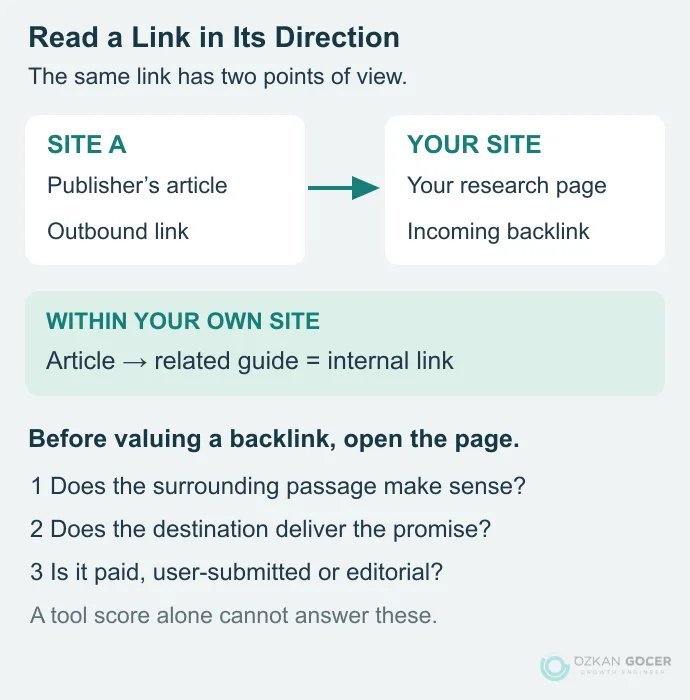
A report containing hundreds of links may look impressive until you notice that most come from the same website's footer. Start by opening a linking page. Read the sentence around the link and follow it to its destination; a score cannot tell you whether that journey makes sense.
Backlinks, Internal Links and Outbound Links
The name depends on your point of view. A link from a magazine to your study is an outbound external link for the magazine and an incoming backlink for you. A link from that study to another page on your own website is an internal link.
Separate the number of links from the number of referring domains, the different domains linking to you. Forty links from one website and one link from each of forty websites describe different patterns. Neither pattern proves quality without looking at the actual pages.
How Do Backlinks Affect SEO?
Google describes link analysis and PageRank as part of its ranking systems. Links help it understand relationships between pages and discover new addresses. That does not mean the page with the largest backlink count wins, or that search rankings can be reduced to three fixed factors.
Consider a link pointing to a deleted product page. Visitors reach an error instead of the promised information. If the URL redirects, check the final destination. If the content cannot be accessed or indexed, investigate those technical SEO issues before trying to acquire more links.
A ranking increase after a new link is not proof that the link caused it. The content, competitors and search demand may have changed too. Track referral visits, the target page's relevant queries and useful visitor actions together.
Followed, Nofollow, Sponsored and UGC Links
“Dofollow” usually means an ordinary link without a qualifying relationship attribute. You do not need to add rel="dofollow". The other attributes describe a publisher's relationship with the link; Google's documentation explains their intended use.
Scroll sideways to read every column. Keyboard: focus the table and use the arrow keys.
| Attribute | Meaning | Assessment |
|---|---|---|
| Ordinary link | No special relationship attribute. | It does not prove editorial quality or a ranking gain. |
| nofollow | The publisher may not want to associate the destination with its site in the usual way. | Readers can still click; it is not a statement that the link has no audience value. |
| sponsored | Advertising or a paid placement. | Do not report purchased exposure as independent editorial endorsement. |
| ugc | User-generated content such as comments or forum posts. | Distinguish a contributor's link from the publisher's own recommendation. |
There is no prescribed percentage that makes a backlink profile natural. Adding forum links just to balance a spreadsheet misses the point. Ask whether each link belongs in the conversation.
How to Assess a Backlink
Imagine a printing publication linking to your paper-weight comparison. Your page explains the samples, date and limitations, and the publication uses it to help readers choose stock. Compare that with a page selling unrelated products and inserting the same link between them. The first has an understandable editorial reason. This is an assessment example, not a measured ranking experiment.
- Read the surrounding passage. What does the link support? Would the article still be useful without it?
- Open the destination. Check for the expected content, language and any redirects.
- Examine the anchor text. Does the clickable wording describe what readers will find? Has a commercial phrase been forced into unrelated sentences?
- Establish the arrangement. Was money, a product or a reciprocal link required? How is that relationship disclosed?
- Consider the audience. Would readers of the source genuinely use the research, tool or explanation at the destination?
DA, PA and DR are metrics produced by different tools. Ahrefs explicitly explains that DR is not a Google ranking factor. Such metrics can help shortlist sources, but they cannot replace reading the page. The separate explanation of DA and PA covers how those scores differ.
How to Earn Backlinks
Begin with the reason a publisher would cite you. A small study with a clear method, a downloadable worksheet, comparable examples or an up-to-date technical explanation gives someone a concrete resource to reference. Writing around the reader's search intent helps the page answer a real question; it cannot ensure that another publisher will link to it.
- Make the original resource easy to use. State when data was collected, how it was gathered and what it does not show. Keep a useful table available as text, not only inside an image.
- Read potential publications. Identify the specific gap your resource fills. If you cannot explain the fit in one sentence, remove that publication from the shortlist.
- Offer a suitable replacement for an outdated source. Report a broken link when helpful, but suggest your own page only if it answers the same need.
- Contribute relevant expertise. Answer a journalist's actual question with evidence or examples. A PR campaign can produce useful coverage without every mention becoming a link.
An illustrative outreach note might say: “The paper-selection table linked from your article is no longer available. We have published a comparison of the same weights with practical examples, methods and limitations. You are welcome to consider it if it would help your readers.” This is a sample message, not a reported outreach result. Leave the publisher free to choose whether and how to cite you.
Free Backlinks and Relevant Places to Contribute
A free placement is not automatically appropriate. A genuine business listing, membership profile or helpful community answer may include a useful link. Accounts created solely to drop links, repetitive comments and unrelated directory submissions offer little to the audience. Choose places your readers actually use rather than working through a bulk list of “free backlink sites.”
Backlink Costs and Paid-Placement Risks
There is no reliable universal backlink price list. Paying for research, writing and publisher relations is different from buying a link with a promised ranking effect. “Cheap,” “high DR” and “guaranteed” do not establish either audience value or compliance with Google's policies.
Google's link spam policy addresses buying and selling links to manipulate rankings, along with other link schemes. Properly qualified advertising and sponsorship links are treated differently. Ask a service provider for the proposed page, content, relationship attribute, removal terms and reporting method. A guaranteed first position is not a meaningful delivery standard.
A private blog network, or PBN, is a network operated to generate links. Appearance alone may not establish how a network is run, but unrelated content and repeated sales patterns warrant closer inspection. Links inserted into somebody else's website without permission are not a legitimate acquisition method.
Where to Check Existing Backlinks
For your own website, open Links → External links in Search Console and drill down through the target page and linking site to inspect source URLs. The Links report is a sample rather than a complete live inventory. It can include links that have since disappeared and does not identify nofollow links.
Use backlink checking tools for competitor research or another sample of the web. Their crawl coverage and update schedules differ, so unequal counts do not automatically mean an error. Keep a worksheet with source URL, destination, anchor, attribute, check date and decision; the notes make later reviews much more useful.
What to Do About “Toxic” Backlinks
A tool's risk score is not a Google penalty. Check that the link exists, investigate how it was acquired and review Search Console's Manual Actions report. Do not automatically turn every unfamiliar domain into a disavow entry.
Google's disavow guidance requires two conditions together: a substantial quantity of artificial, spammy or low-quality links, and a manual action caused or likely to be caused by those links. Where action is necessary, try removal first. Most websites do not need the tool; an incorrect list can affect useful links as well.
If a review establishes the need to disavow, check the correct URL-prefix property, scope and existing file. A new upload replaces the old list. Follow the official file instructions rather than an automated “clean everything” export. The Search Console guide explains how to distinguish its different reports.
Backlinks in AI Search and Measuring Results
A strong backlink profile does not promise a citation in an AI answer. Google says its general SEO foundations still apply to AI search features. Being accessible, answering the question and being selected as a source are different outcomes, a distinction also covered in the discussion of Google AI Mode and SEO.
Before starting acquisition work, name the page and reader need you want publishers to reference. Afterwards, check whether links remain live, destinations work and relevant visits or queries change. Increase effort because the resource and audience fit are working, not simply because a backlink counter has gone up.