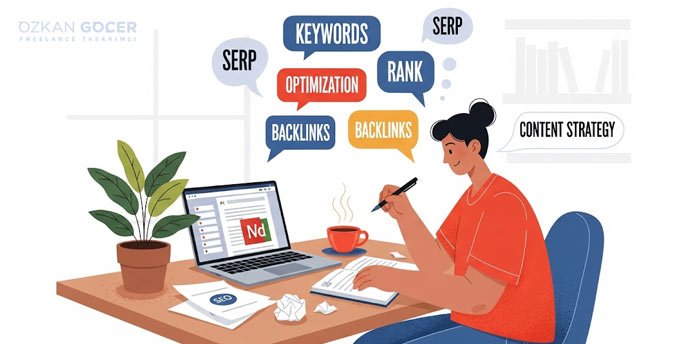
SEO writing is a repeatable production process, not a bag of tricks. Most online guides repeat basic checklists about titles and meta tags. They ignore search intent analysis and the 2026 AI search environment. I avoid that. I will show you how to build a high-performing article based on real field data. Run your production using this workflow template.
What Is SEO-Friendly Content?
SEO-friendly content is a direct answer to a specific search query, built to satisfy both search engine algorithms and human readers. Forget keyword stuffing; modern optimization requires scannable, trustworthy, and technically clean pages that solve actual user problems. Google's helpful content guide sets a strict standard: write for people first, then format for search engine crawlers. Focus on clarity.
Why SEO Writing Matters in 2026
Organic search outlasts paid campaigns: ads stop the moment your budget runs out, but ranked content keeps drawing traffic for years. AI search engines in 2026 evaluate identical quality signals to select their sources. Optimized pages win on two fronts by ranking in standard Google search and serving as a citation source in AI Overview and ChatGPT. Unoptimized pages simply disappear.
Before You Write a Word: Search Intent Analysis
Ignoring search intent is the fastest way to waste a content budget. Intent represents the exact goal a user wants to achieve when typing a query. Misinterpreting this goal dooms your page to search engine invisibility. Alignment is everything.
The Four Types of Search Intent
Users search with four distinct motivations: informational (how-to guides), navigational (brand searches), commercial investigation (product comparisons), and transactional (purchase intent). A query like "what is a backlink" demands an educational breakdown. Conversely, "best SEO tool" requires a direct comparison list. Match the wrong format and your rankings drop to zero.
Validating Intent by Analyzing the SERP
Stop guessing what users want. Run a manual search for your target keyword and study the top 10 results. Google's SEO starter guide explains how the algorithm evaluates search intent and quality. If listicles dominate the first page, build a listicle. If deep guides rank, write a guide. The search engine results page (SERP) dictates your content structure.
Keyword Selection and Content Structure
Map your target terms and outline immediately after defining user intent. You need one primary keyword, supported by secondary semantic phrases and long-tail variations. Targeting long-tail phrases of three or more words bypasses high-authority competition and usually converts better. My keyword research guide details the exact process of extracting these terms using professional software. It works.
Structure your document using a strict hierarchy of H1 for the main title, H2 for main sections, and H3 for subheadings. Each H2 needs to answer a specific sub-question. I extract these questions directly from Google's "People Also Ask" (PAA) boxes when building content outlines. Direct, clear answers to these queries increase your probability of securing featured snippets. Simple formatting wins.
SEO-Friendly Titles and Meta Descriptions
The title tag is your primary lever for organic click-through rate (CTR). You must restrict titles to 50 to 60 characters, position the main keyword near the start, and add numbers or dates to capture attention. While the 150-160 character meta description bypasses direct ranking algorithms, it acts as your ad copy to capture clicks. Craft a description containing your keyword, generate interest, and close with a clear call to action. Weak titles waste top rankings.
Writing the Intro, Body, and Conclusion
In the SEO campaigns I manage, capturing a reader takes under three seconds. You must answer the search intent in your very first sentence instead of wasting space on fluff like "in today's fast-paced digital world." Keep body paragraphs under four sentences, breaking up the layout with bullet points, data tables, and bold key phrases. Wall-of-text formatting spikes bounce rates. Finish with a direct call to action instead of repeating your introduction. Action drives conversions.
Keyword Usage: Coverage, Not Density
Old keyword density rules no longer apply in the 2026 search environment. Forcing a 2% keyword frequency triggers search penalties because Google measures semantic topic coverage rather than raw word repetition. You must place your primary keyword naturally in the title, the first paragraph, and a single H2 heading. Populate the remaining text with related semantic terms. Deep coverage wins.
Internal Linking and Topic Clusters
A link should tell readers what they will find on the next page. When a paragraph discusses choosing a source, link to a page that helps with that choice; a shared keyword alone does not make another article useful. See the internal linking examples for ways to match an older article and a specific passage to the reader’s next question.
Image and Media Optimization
Unoptimized media consistently damages search rankings and page speed. You must write descriptive alt text for every image to assist search engine indexing and user accessibility; refer to the MDN img documentation for proper attribute formatting. Convert your files to WebP and apply compression to protect your Core Web Vitals scores. Rename generic camera outputs to descriptive structures like seo-content-example.webp. Skip meaningless stock photos.
Demonstrating E-E-A-T
Google evaluates search quality through Experience, Expertise, Authoritativeness, and Trust (E-E-A-T), prioritizing firsthand experience above theoretical knowledge. You can read the official parameters in Google's E-E-A-T announcement. Articles that carry raw campaign screenshots and direct performance data outperform generic guides. AI tools cannot replicate physical testing or proprietary data. Prove your expertise by publishing actual test results, linking to verified external databases, and maintaining transparent author profiles. Proof builds search rankings.
Writing SEO Content in the AI Era
In a 2026 workflow, AI belongs in the research seat rather than the writer's seat. Google ranks AI-assisted content only when you inject firsthand experience and proprietary data. Raw drafts fail. Speed up your outline creation with algorithms, then rewrite the copy manually. I structure my content with direct definitions and Q&A formats. Clear formatting helps Large Language Models (LLMs) and AI Overview cite your site directly.
SEO-Friendly Content Checklist
Run every draft through a strict quality control pass before publishing, because a single structural gap can cost you rankings.
- Search intent: Match your page format to the top 10 Google results.
- Keywords: Distribute your primary and semantic terms naturally across the copy without keyword stuffing.
- Title and meta: Keep your title under 60 characters and your meta description under 160 characters.
- Structure: Build a logical H1-H2-H3 outline that directly answers search queries.
- Readability: Break up dense text blocks using bullet points, tables, and bold formatting.
- Internal links: Connect related pages using descriptive, natural anchor texts.
- Images: Convert files to WebP format and write descriptive alt tags for each image.
- E-E-A-T: Add original data, cite external sources, and display a clear author bio.
- Technical performance: Optimize page speed to meet Core Web Vitals standards.
Common Mistakes When Writing SEO Content
- Skipping search intent: Writing copy before analyzing the live SERP guarantees zero organic visibility. You waste budget on pages nobody wants to read.
- Keyword stuffing: Forcing exact-match phrases into every heading triggers algorithmic penalties and alienates human readers. Write naturally instead.
- Weak titles: Bland headlines kill your click-through rate (CTR) even if you secure the top spot. CTR directly influences long-term rankings.
- Walls of text: Huge blocks of text spike your bounce rate instantly. Modern readers scan; format with short paragraphs and clear subheadings.
- Writing without experience: Copying generic search results destroys your Experience, Expertise, Authoritativeness, and Trustworthiness (E-E-A-T) signals. Search engines easily identify low-value, repetitive content.
- Neglecting internal links: Leaving new pages orphaned stops search crawlers from discovering them. Link your content strategically to distribute authority.
Ranking highly requires matching actual search intent rather than chasing arbitrary word counts. You must master a strict workflow: analyze intent, map keywords, build the structure, draft, optimize, and inject E-E-A-T. Start by searching your target query, study the top 10 competitors, and map their content angles. Write for the human user first, then format for search bots. Stick to this order.
If you want to grow your organic visibility professionally, you can take a look at the SEO services I offer.