What Does "Free" Mean? The App Is Free, the Trade Is Not
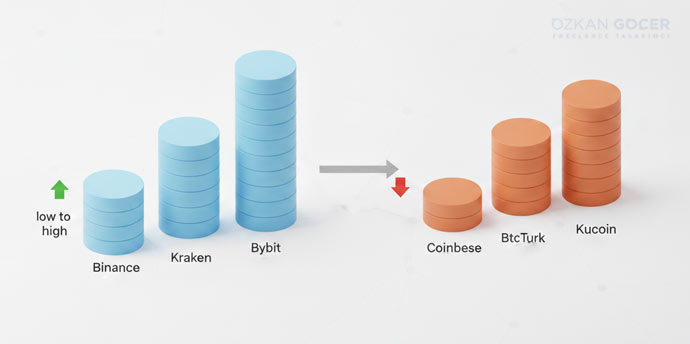
Downloading a crypto app and opening an account is free most of the time; portfolio trackers and data apps are usually free end to end. The picture changes once you start trading: on exchange apps you pay a commission and a spread (the buy-sell gap) on every order. How far that commission varies between venues is set out for 12 platforms in crypto exchange commission rates.
Two ideas are worth separating. Read the fine print under "0% commission" or "free trades" ads; the cost often hides in the spread or depends on specific conditions. Withdrawal and network (blockchain) fees also leave your pocket. The app can be free, but the trade rarely is.
The misunderstanding I correct most often while advising is exactly this: a free app does not mean a free trade. To see the cost, I suggest tracking prices with a free data app such as CoinGecko and reading the exchange's fee page separately.
Exchange and Trading Apps
Exchange apps are where you buy and sell crypto. In Turkey, local platforms (such as BtcTurk and Paribu) and Turkish versions of global exchanges (such as Binance TR) are widely used; on the global side Coinbase and Kraken are well known. Most of them store the crypto you buy; that is practical, but the keys stay with the exchange.
Legality is a key point. Crypto service providers in Turkey are now subject to legal regulation and licensing; choosing a legal platform registered with MASAK is basic safety. Compare which exchange fits you on commission, security, Turkish Lira support and customer service; I detailed these criteria in my reliable crypto exchanges article.
Portfolio Tracking and Market Data Apps
Tracking apps do not trade; they follow prices, gather your portfolio on one screen and help you learn the market. CoinGecko and CoinMarketCap are the best-known names here and are largely free.
For a beginner, the healthiest first step is to watch the market for a few weeks with a tracker before depositing money. The price of one Bitcoin keeps changing; instead of a fixed figure, you read the live rate in these apps and see for yourself how volatile the price is by looking at the chart and history.
Crypto Wallet Apps
Wallet apps are tools where you store your crypto under your own control. MetaMask and Trust Wallet are the best-known examples; their difference from an exchange is that the secret recovery phrase (seed phrase) stays with you. The control is fully yours, and so is the responsibility.
Wallets are either "hot" (connected to the internet, practical but riskier) or "cold" (hardware, offline, the safest). Keeping a small amount you actively use in a hot wallet and a large amount you store long term in a cold wallet is a common approach. If you want to set up a wallet, you can follow my guide to creating a crypto wallet; never share your recovery phrase with anyone, under any circumstance.
Security: How to Avoid Fake Apps
Fake exchange and wallet apps are a common scam; copies that closely resemble the real thing can slip even into the stores. The first rule of protection is to download an app only from an official source: the link on the platform's official site or a verified developer account.
Before installing, check the app name, the developer, the download count and the reviews; imitations carry small differences in the name. Turn on two-factor authentication (2FA), be suspicious of apps asking for needless permissions and, most importantly, never enter your secret recovery phrase into any app. Real apps never ask for it.
- Download only from the official site or a verified store account.
- Verify the developer name, download count and reviews.
- Turn on 2FA; never write your recovery phrase anywhere.
- Do not touch links that ask you to install with a "guaranteed profit" or "airdrop" promise.
How to Choose the Best Crypto App
The "best" app depends on your need; there is no single right answer. First clarify your goal: do you want trading, tracking or storage? Once the goal is clear, the right category appears on its own.
After picking the category, look at security (2FA, history, reputation), fees (commission, spread, withdrawal), legal status (licensed in Turkey or not), Turkish Lira and language support, and ease of use. For a start, a well-known, compliant exchange plus a free tracking app is a reasonable combination. You can find options close to your need together in my best crypto apps comparison.
The Truth About "Earn Free Crypto" Apps
Treat "earn free crypto from your couch" or "tap to earn" apps with great caution. Most either hand out worthless tokens, make you watch heavy ads while harvesting data, or are outright scams. The bigger the "free money" promise, the higher the risk.
Real airdrops, the free token distributions by some projects, do exist; yet they are often worthless too or imitated by scammers. Connecting a wallet to such apps, entering your recovery phrase or making a payment is very risky. The earnings promised for your time and effort usually turn out worthless; stay skeptical. The content is for information only and is not investment advice.