Quick Verdict: Which Should You Buy?
Let us start with a clear answer. If you want the macOS ecosystem, class-leading single-core performance, and seamless app compatibility, Apple M4 stands out. If you are tied to Windows, want long battery life and a strong NPU, and the apps you rely on run well on ARM, Snapdragon X Elite makes sense. From a developer's view, the real deciding factor is not raw speed but which platform runs your daily tools smoothly.
Two Architectures at a Glance (Qualcomm ARM vs Apple Silicon)
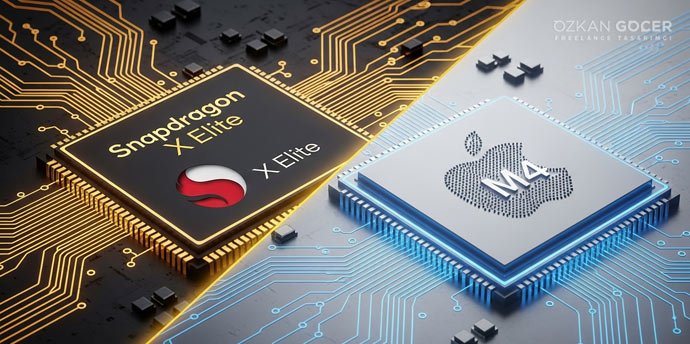
Both chips are ARM-based, meaning they come from the same core architecture family, but they belong to different worlds. Apple M4 is part of the Apple Silicon family and is found only in Macs running macOS; designing hardware and software under one roof yields high efficiency. Snapdragon X Elite is Qualcomm's chip for Windows laptops and appears across many brands in the "Copilot+ PC" class. I cover the role of AI in these chips in my artificial intelligence article.
Performance: CPU, GPU, NPU, and Battery
Performance is best judged in four areas: CPU, GPU, NPU, and battery life.
What the benchmarks add up to
A summary that simplifies the general trend:
Scroll sideways to read every column. Keyboard: focus the table and use the arrow keys.
| Area | Apple M4 | Snapdragon X Elite |
|---|---|---|
| Single-core | Class-leading | Strong, slightly behind |
| Multi-core | Very good | Competitive |
| GPU | Strong and efficient | Good |
| NPU (AI) | Strong | Very strong |
| Battery life | All-day | All-day |
The table sums it up: M4 leads in single-core efficiency, while the X Elite is very competitive in multi-core and NPU. Confirm real benchmarks from independent measurement sources, because results vary by laptop model and cooling; raw GHz alone does not reflect performance.
The Decisive Factor: Software and App Compatibility
The real decision is made here: software and app compatibility. However fast the chip, if your programs do not run well on that platform, the speed means nothing.
Windows-on-ARM emulation vs the macOS ecosystem
On the Snapdragon X Elite, native ARM apps run great; apps written for x86 run via emulation and most work fine, but some older software, drivers, and games can have compatibility issues. On Apple's side, M4 has broad app support after a mature transition plus a translation layer, which runs most tools smoothly. If you are a developer, check before buying whether your compiler, virtualization, and development tools run natively or via emulation on the platform; for example, languages like Go are well supported on both, but your entire toolchain may not be equally mature.
Ecosystem: MacBook vs Copilot+ PC
The decision often depends on the ecosystem more than the chip. Choosing Apple M4 means entering the MacBook and macOS world: consistent hardware, long software support, and a tightly integrated ecosystem, but a more closed structure and usually a higher price. Snapdragon X Elite offers many brands, prices, and designs in the Copilot+ PC class: more flexibility and Windows compatibility, but quality that varies from device to device. Which you choose depends on whether you want an open, flexible Windows environment or a consistent, integrated Mac experience.
Clearing It Up: X Elite vs the Newer X2 Elite
There is a point that is often confused: the Snapdragon X Elite is not the same as the X2 Elite. The X2 Elite is the newer generation that targets higher performance. When comparing "Snapdragon X Elite vs M4," pay attention to which generation you are comparing, because benchmarks differ noticeably by generation. Verify which chip and which device a number in a review refers to; otherwise you may mistake an older-generation result for a new one. You can confirm official technical details from the Qualcomm and Apple pages.
Value: Who Doesn't Need This Much Power?
Finally, price and value. Both chips are more than powerful enough for everyday work (web, office, video); if that is all you do, the decision can be made on battery, ecosystem, and price, because both offer more than you need. Heavy content creators, and those who compile, virtualize, or run local AI workloads, truly benefit from this power, and the difference becomes meaningful. Follow independent reviews and price comparisons from hardware review sources; the right question is not "which is faster" but "which platform runs my workflow smoothly and at the right price."