What Is Golang? Why Did Google Develop It?
Go, commonly Golang, is an open-source, compiled programming language developed by Google. It was designed at Google in 2007 and opened to the public in 2009. The aim was to solve the slow compilation, complex code and concurrency difficulties faced in large-scale software systems.
Go does this with three goals: simplicity (plain, easy-to-read syntax), speed (it runs fast because it is a compiled language) and concurrency (managing many tasks efficiently). The name "Golang" comes from the language's old website golang.org; its official name is Go and the current source is go.dev. Today it is a modern language much preferred especially in the server, cloud infrastructure and DevOps world.
Go's Core Features
A few design decisions set Go apart from other languages. The most obvious is simplicity: the language has few keywords and features and reduces confusion with a "one right way" approach. Because it is compiled, the code is turned into machine code before running and runs at high speed.
Go can also produce a single executable file; this makes deployment much easier. Its static typing catches errors early, and its built-in tools (formatting, testing) keep a standard. These plain but powerful features make Go both easy to learn and reliable in production; it is a valuable language for those planning a software career.
Goroutines and Concurrency: Go's Real Power
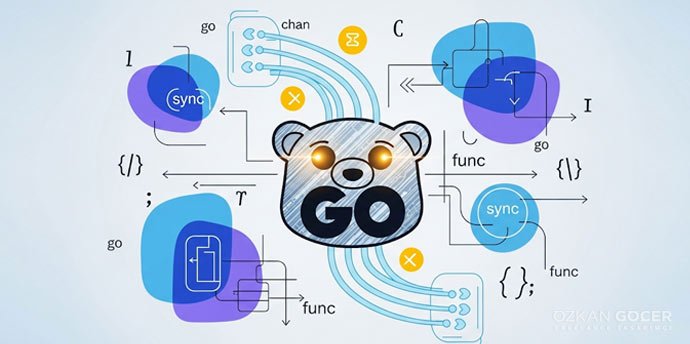
Concurrency is a program's ability to run multiple tasks at the same time; for example, a server handling thousands of requests concurrently. Go does this with very lightweight structures called "goroutines". Because a goroutine consumes far fewer resources than a classic thread, a Go program can run thousands or even hundreds of thousands of goroutines at once.
Go also offers the "channel" structure, which makes data exchange between goroutines safe. The practical result is that writing high-traffic servers and network services with Go is both easy and efficient. Concurrency being this plain and powerful is the most distinctive feature that sets Go apart from many languages, and the main reason it is so loved in the cloud world.
What Can You Build with Go? Where Is It Used?
Go shines especially in server-side software that needs high performance and concurrency.
- Backend and API: fast and scalable web services.
- Cloud and DevOps: the sector's two giants, Docker and Kubernetes, are written in Go.
- Microservices: small, independent services.
- CLI tools: fast command-line tools that can be distributed as a single file.
- Network programming and system tools.
Go is preferred because it offers near-C speed while being quite plain and readable and makes concurrency easier. Tools like Docker and Kubernetes being written in Go is the best example of the language's place in this area. So it is a perfect fit for systems that must handle many requests at once, fast.
Go's Advantages and Disadvantages
Like any language, Go has strong and weak sides; what decides it is the job you use it for.
Advantages: high runtime speed, plain and readable syntax, strong and easy concurrency, fast compilation, single-file deployment and a strong position in the cloud and DevOps ecosystem. Disadvantages: because the language is deliberately kept plain, some developers find it too limited; it is not as common as Python in areas like desktop interfaces, mobile or data science and AI; and because it is relatively young, some library ecosystems are narrower than in more mature languages. Overall, Go is a very strong choice in the right area (server, cloud, high performance).
Is Go Hard? How Do You Learn It?
Go is generally considered one of the easiest modern languages to learn; especially compared with complex languages like C++ or Rust. Its design philosophy is deliberately built on simplicity, so someone with prior programming experience grasps Go's basics in a relatively short time.
To learn it, the official interactive tutorial A Tour of Go is an excellent start; then reinforcing by writing small projects (for example a simple API) is the most effective way. Of course, advanced topics like concurrency (goroutines, channels) need practice until you master them. Writing code rather than just watching is, in Go too, the main method that speeds up learning.
The Difference Between Go and Python
The two are strong for different purposes. Python is an interpreted language; it is very easy to write, flexible and the sector leader especially for data science, AI, automation and rapid prototyping; but its runtime speed is usually slower than Go.
Go is a compiled language; its runtime speed is high and it is very strong in concurrency, so it is ideal for high-performance backend, cloud infrastructure and microservices. Which to learn? Python for data science, AI or a general-purpose start; Go if you target high-performance servers, the cloud or scalable backend. The two are not rivals but complementary; many companies use Python on the data side and Go in performance-critical services together. For a comparison with other languages, you can also look at my what is PHP article.