WEB TECHNOLOGİES GUİDE: TRANSİTİON FROM WEB 1.0 TO WEB 4.0 AND DİFFERENCES

Web Technologies Guide: Transition from Web 1.0 to Web 4.0 and Differences

Web 3.0 (Web3) is the envisioned next phase of the internet, built around decentralization, and summed up as "read-write-own." Below you will find what it is, the Web 1.0-2.0-3.0 evolution, the core technologies, what it makes possible, real examples, an honest look at whether it "failed," and whether AI will replace it. I recommend no coin; none of this is investment advice.

What Is Web 3.0 in Simple Words?

Web 3.0 (or Web3) is the envisioned next phase of the internet, built around the idea of decentralization. Its core claim: on today's internet (Web 2.0), our data and content are largely controlled by a handful of giant companies (big tech platforms); Web 3.0 aims to give that control back to users, so data and digital assets genuinely belong to users. The main technology making this possible is the blockchain.

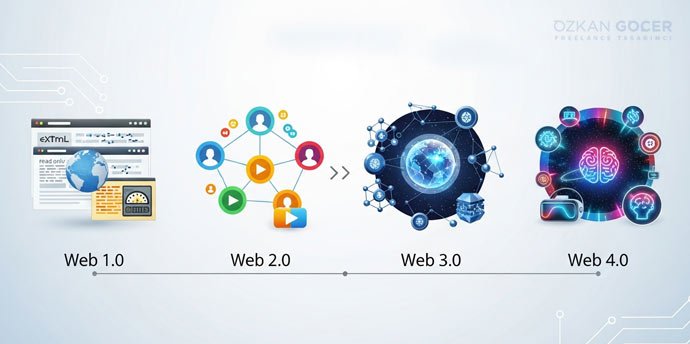
A famous phrase sums it up: Web 1.0 was "read," Web 2.0 is "read-write," and Web 3.0 is "read-write-own." In simple words, Web3 envisions an internet where you own your data and digital assets without depending on intermediary companies, and where decentralized applications (like DeFi, NFTs, and DAOs) can run. An important note: Web 3.0 is still an evolving concept and vision; there is not one fully mature, ready-made "Web 3.0" yet, and how much of it will actually materialize is debated. You can examine the source of the vision on ethereum.org.

The Evolution of the Web: 1.0, 2.0, and 3.0

Understanding the web's evolution in three phases is the key to grasping Web 3.0. Web 1.0 ("read") was the internet's early era (roughly the 1990s to early 2000s); mostly static websites, where users could only read content with little interaction, so the web was like a digital library or newspaper. Web 2.0 ("read-write") is the internet we use today; social media, blogs, video platforms, and e-commerce let users create content, share, and interact, but that content and data are largely held on and controlled by centralized companies (big platforms).

Web 3.0 ("read-write-own") is the envisioned next phase: a blockchain-based, decentralized internet where users go beyond creating content to actually owning their data and digital assets. So the core difference is about control and ownership: in Web 2.0, platforms control; in Web 3.0, ideally, users own. You can find the history of this evolution in international sources too; the numbering represents different answers to the question of "who holds" the internet.

The Core Technologies of Web3

The main technologies enabling the Web 3.0 vision are these:

  • Blockchain: Web3's backbone; a distributed, tamper-resistant record system that works without a central authority.
  • Cryptocurrencies and tokens: the value layer of the Web3 economy, powering digital ownership, payments, and incentives.
  • Decentralization: running data and apps across distributed networks rather than one company's servers.
  • Smart contracts: self-executing programs without intermediaries; the foundation of decentralized apps.
  • AI and the semantic web: in some definitions, Web 3.0 also describes a web where machines process content more meaningfully.

A small clarification: "Web 3.0" has two emphases; one centered on blockchain and decentralization (Web3), the other on the semantic web and AI. Most current usage means blockchain-based decentralization. Together, these technologies form the vision of a "user-owned, intermediary-free" internet; cryptocurrency's role in this structure is to provide the value and ownership layer.

Real-World Examples of Web3

Concrete examples of Web 3.0 include decentralized finance (DeFi) protocols, NFTs for digital ownership and collectibles, decentralized organizations (DAOs), decentralized apps (dApps) such as games and marketplaces, crypto wallets, and decentralized identity; platforms like Ethereum form the infrastructure of this ecosystem.

About "web3 coins," an important warning is needed: some Web 3.0 projects have their own tokens or coins, but these, like all crypto assets, are highly speculative and risky and can lose all their value. A technology being talked about as "the future of the internet" does not mean its associated coins will profit. The content here is not investment advice and no coin is recommended; "buy a web3 coin and get rich" messaging is usually speculation and marketing. If interested, do your own research (DYOR), never invest money you cannot afford to lose, and beware of scams. In the US, crypto assets may be treated as securities and the space is subject to regulation; you can follow the regulator's guidance at the SEC and use only reputable, regulated platforms.

Does Web 3.0 Already Exist?

Partly yes, but not fully. Web 3.0 is not a single product with an on/off switch; it is a gradual vision, and some of its components already exist and work today: cryptocurrencies, DeFi protocols, NFTs, DAOs, and decentralized apps are all real and in use right now. So in that sense, pieces of Web3 are already here.

The broader vision, though, a fully decentralized internet that mainstream users adopt in place of today's Web 2.0, does not yet exist in a mature, widespread form. Most people still use centralized platforms for the vast majority of their online activity, and Web3 apps remain a relatively small (and often complex) niche. So the honest answer is that Web 3.0 partly exists in specific applications but is far from a complete, dominant reality. It is more accurate to think of Web3 as an ongoing experiment and transition than a finished product, and whether it becomes the internet's mainstream future is still an open question.

Why Did Web 3.0 'Fail'? (The Hype vs Reality)

An honest, balanced take is needed, since Web 3.0 draws both big excitement and serious criticism. The "Web3 failed" narrative grew for several reasons: hype cooled, because Web3 (and crypto and NFTs) saw enormous hype around 2021 followed by a sharp downturn, with many high-profile projects collapsing or not delivering; complexity remained, because wallets, gas fees, and security risks create friction for ordinary users; and the decentralization claim was questioned, because in practice some projects concentrated control among certain investors or actors.

Scams and excessive speculation also overshadowed the space and damaged trust, and critics argue many Web3 ideas did not solve real, widespread needs (a "solution looking for a problem"). So "failed" is too strong: some Web3 ideas (digital ownership, DeFi) are real and still developing, but the grand vision did not materialize as the 2021 hype promised, and the excitement clearly faded. The realistic verdict is neither "guaranteed future" nor "total failure," but an evolving, contested area where hype warrants caution. You can read balanced background in general sources too.

Will AI Replace Web3?

People often ask this, partly because AI took over the tech spotlight after Web3's hype faded around 2023. The realistic view: AI and Web3 are not necessarily competitors that "replace" one another; they are different things that can also combine. AI is about machines that learn, generate, and reason, while Web3 is about decentralization and ownership via blockchain, so they address different problems. What actually happened is that attention and investment shifted heavily toward AI, which made Web3 feel less prominent, but that is a shift in hype, not a technical "replacement."

Looking forward, the two can intersect: AI could power smarter decentralized apps, and Web3 ideas (like verifying ownership or provenance) could matter in an AI-heavy world, for example proving what is authentic versus AI-generated. So rather than AI "replacing" Web3, it is more accurate to say AI currently overshadows Web3 in attention, while the two may end up complementing each other. Predicting which one "wins" is speculative; both are still evolving, and the numbering of Web 1, 2, 3, and 4 is best treated as a rough map of direction rather than fixed milestones.

FAQ

Frequently Asked Questions

Quick answers for readers who skipped to the end.

What is Web 3.0 in simple words?
Web 3.0 (or Web3) is the envisioned next phase of the internet, built around the idea of DECENTRALIZATION. Its core claim: on today's internet (Web 2.0), our data and content are largely controlled by a handful of giant companies (big tech platforms); Web 3.0 aims to give that control back to users, so that data and digital assets genuinely BELONG to users. The main technology making this possible is the blockchain. A famous phrase sums it up: Web 1.0 was "read," Web 2.0 is "read-write," and Web 3.0 is "read-write-OWN." In simple words: Web3 envisions an internet where you own your data and digital assets without depending on intermediary companies, and where decentralized applications (like DeFi, NFTs, and DAOs) can run. IMPORTANT NOTE: Web 3.0 is still an evolving CONCEPT or vision; there is not one fully mature, ready-made "Web 3.0" yet, and how much of it will actually materialize is debated. This is for general information.
What is the difference between Web 1.0, Web 2.0, and Web 3.0?
Understanding the web's evolution in three phases is the key to grasping Web 3.0: (1) WEB 1.0 ("Read"), the internet's early era (roughly the 1990s to early 2000s). Mostly STATIC websites; users could only READ content, with little interaction. The web was like a digital "library or newspaper." (2) WEB 2.0 ("Read-Write"), the internet we use today. Social media, blogs, video platforms, and e-commerce let users CREATE content, share, and interact. But that content and data are largely held on and controlled by CENTRALIZED companies (big platforms). (3) WEB 3.0 ("Read-Write-Own"), the envisioned next phase: a blockchain-based, DECENTRALIZED internet where users go beyond creating content to actually OWNING their data and digital assets. So the core difference is about CONTROL and OWNERSHIP: in Web 2.0, platforms control; in Web 3.0 (ideally), users own. This evolution represents different answers to the question of "who holds" the internet. This is for general information.
What are Web3's core technologies?
The main technologies enabling the Web 3.0 vision: (1) BLOCKCHAIN, Web3's backbone; a distributed, tamper-resistant record system that works without a central authority, enabling ownership, transactions, and trust to be established in a decentralized way. (2) CRYPTOCURRENCIES & TOKENS, the value layer of the Web3 economy, powering digital ownership, payments, and incentive mechanisms. (3) DECENTRALIZATION, running data and apps across distributed networks rather than one company's servers. (4) SMART CONTRACTS, self-executing programs without intermediaries (especially on platforms like Ethereum); the foundation of decentralized apps. (5) AI & THE SEMANTIC WEB, in some definitions, Web 3.0 also describes a web where machines process content more "meaningfully" (semantic) and AI delivers smarter, personalized experiences. (6) DECENTRALIZED IDENTITY and data storage. Note: "Web 3.0" has two emphases, one centered on blockchain/decentralization (Web3), the other on the semantic web/AI. Most current usage means blockchain-based decentralization. This is for general information.
What are real-world examples of Web3, and should I buy "web3 coins"?
Concrete examples and application areas of Web 3.0: (1) DECENTRALIZED FINANCE (DeFi), intermediary-free lending or swapping protocols. (2) NFTs, digital ownership and collectibles. (3) DAOs, decentralized organizations or communities. (4) DECENTRALIZED APPS (dApps), games, social platforms, marketplaces. (5) CRYPTO WALLETS and decentralized identity. (6) Platforms like Ethereum form the infrastructure of this ecosystem. About "WEB3 COINS," an IMPORTANT WARNING: some Web 3.0 projects have their own tokens or coins, but these (like all crypto assets) are highly SPECULATIVE and RISKY; they can lose all their value. A technology being talked about as "the future of the internet" does NOT mean its associated coins will profit. This content is NOT investment advice and no coin is being recommended. "Buy a web3 coin and get rich" messaging is usually speculation and marketing; if interested, do your own research (DYOR), never invest money you cannot afford to lose, and beware of scams. Use only reputable, regulated platforms (in the US, note crypto may be treated as securities and is subject to SEC oversight). This is for general information.
Does Web 3.0 already exist?
Partly yes, but not fully. Web 3.0 is not a single product with an on/off switch; it is a gradual vision, and some of its components already EXIST and work today: cryptocurrencies, DeFi protocols, NFTs, DAOs, and decentralized apps are all real and in use right now. So in that sense, pieces of Web3 are already here. HOWEVER, the broader vision, a fully decentralized internet that mainstream users adopt in place of today's Web 2.0, does NOT yet exist in a mature, widespread form. Most people still use centralized platforms for the vast majority of their online activity; Web3 apps remain a relatively small (and often complex) niche. So the honest answer is: Web 3.0 partly exists (in specific applications) but is far from a complete, dominant reality. It is more accurate to think of Web3 as an ongoing experiment or transition than a finished product. Whether it becomes the internet's mainstream future is still an open question. This is for general information.
Why do people say Web 3.0 "failed"?
An honest, balanced take is needed, since Web 3.0 draws both big excitement and serious criticism. The "Web3 failed" narrative grew because: (1) HYPE COOLED, Web3 (and crypto/NFTs) saw enormous hype around 2021, followed by a sharp downturn; many high-profile projects collapsed or did not deliver on their promises, and NFT/crypto enthusiasm dropped significantly. (2) COMPLEXITY, Web3 technologies remain hard for ordinary users; wallets, gas fees, and security risks create friction. (3) DECENTRALIZATION DEBATE, despite the "decentralized" claim, in practice some projects concentrated control among certain investors or actors, so true decentralization is questionable. (4) SCAMS & SPECULATION, fraud and excessive speculation overshadowed the space and damaged trust. (5) "SOLUTION LOOKING FOR A PROBLEM," critics argue many Web3 ideas did not solve real, widespread needs. So "failed" is too strong: some Web3 ideas (digital ownership, DeFi) are real and still developing, but the grand vision did not materialize as the 2021 hype promised, and the excitement clearly faded. The realistic verdict: neither "guaranteed future" nor "total failure," an evolving, contested area where hype warrants caution. This is for general information.
When will Web 3.0 arrive, and what is Web 4.0?
WHEN WILL WEB 3.0 ARRIVE: Web 3.0 has no clear "release date," because it is not a single product but a gradually evolving vision. Some of its components (crypto, DeFi, NFTs, dApps) are already in use; but when (or whether) a "full Web 3.0 internet" becomes widespread is uncertain and seen as a process taking years. So Web 3.0 is not "a door that opens one day" but a transition happening slowly (and perhaps partially). WHAT IS WEB 4.0: Web 4.0 is a far more uncertain, non-standardized, speculative concept about the future. It is generally described as a next phase where AI is much more deeply integrated, machines "understand" and interact like humans, and the physical and digital worlds intertwine (e.g., advanced AI, the internet of things, immersive experiences). But the definition of Web 4.0 is not yet clear and is largely theoretical or predictive; while even Web 3.0 has not fully settled, it is too early to speak definitively about Web 4.0. In short: this numbering (Web 1, 2, 3, 4) consists of labels that roughly describe the internet's evolution; rather than fixed dates and boundaries, it is more accurate to think of it as a general direction of development. This is for general information.
Summarize:
Özkan Göçer profile photo

Özkan Göçer

Growth Engineer & Digital Marketing Specialist

Özkan Göçer is a Growth Engineer and Digital Marketing Specialist with over 15 years of field experience and 200+ completed projects. He incorporates over 15 years of experience working with web technologies, modern development stacks, and digital infrastructures into this content.


Scroll to top