WHAT IS ARTİFİCİAL INTELLİGENCE, HOW DOES IT WORK AND WHERE IS IT USED?

What Is Artificial Intelligence, How Does It Work and Where Is It Used?

Artificial intelligence (AI) describes computer systems designed to mimic human cognitive functions like learning, reasoning, problem-solving, and decision-making. The software identifies mathematical patterns within datasets to predict outcomes in unfamiliar scenarios. Search engines, smartphone cameras, credit scoring algorithms, and generative tools like ChatGPT run on pattern-recognition models. It is not a single technology. The term groups distinct technical disciplines including machine learning, deep learning, and natural language processing.

In my own practice as a growth engineer, I have integrated AI tools for more than seven years to handle content analysis, ad optimization, data clustering, and customer segmentation. I have watched the industry swing between overhyped marketing buzz and actual, practical utility. It is a tool, not magic. Today, understanding "what is artificial intelligence" is no longer just for engineers; it directly affects business owners, students, and everyday users. I will break down how the technology works, its core types, practical examples, and real risks without the usual industry jargon.

What Is Artificial Intelligence?

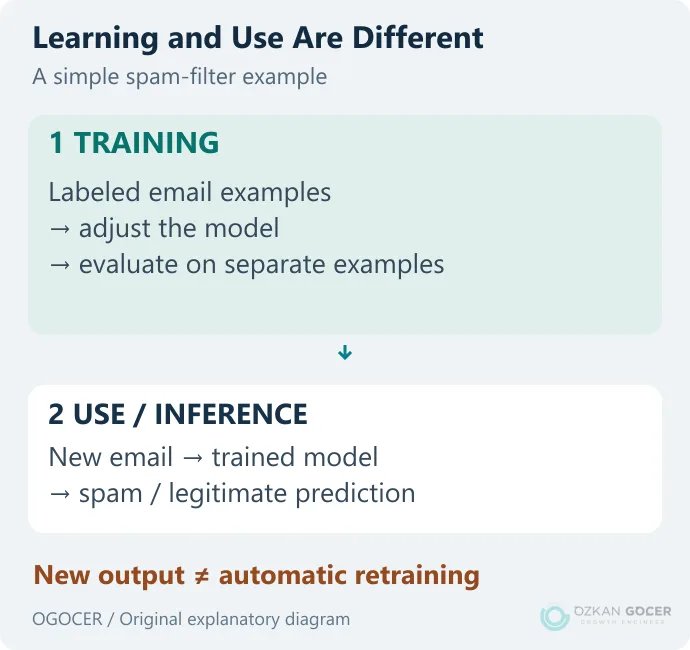
Computer science uses artificial intelligence (AI) to build systems that mimic human cognitive functions. Standard software relies on static, hand-coded rules for every action. AI operates differently by extracting its own rules directly from data. In my own practice as a growth engineer, I observe the transition during data pipeline optimization. Instead of writing thousands of manual filters to catch spam emails, you feed the system millions of examples, allowing the algorithm to detect the underlying pattern independently. Learning never stops.

Academic circles coined the term in 1956, though the core concept originated with Alan Turing's question, "Can machines think?" Modern applications easily surpass those early theoretical limits. You are witnessing a massive shift in the evolution of technology.

A Short History of AI: Who Invented It?

John McCarthy coined the term "artificial intelligence" at the 1956 Dartmouth Conference, earning his reputation as the father of the field. In my own practice analyzing algorithmic systems, I find that tracing history clarifies current tech shifts. The timeline began earlier:

  • 1950: Alan Turing proposed the "Turing Test" to evaluate whether a machine can think.
  • 1956: The Dartmouth Conference established the academic field of AI.
  • 1997: IBM Deep Blue defeated world chess champion Garry Kasparov in a six-game match.
  • 2011: Apple integrated Siri into the iPhone, introducing voice assistants to consumers.
  • After 2022: OpenAI released ChatGPT, putting generative AI directly into public hands.

How Does Artificial Intelligence Work?

In my own practice optimizing web systems, I observe how machine learning relies on three elements: data, algorithms, and computing power. You feed raw data into the system first. Algorithms scan the input to identify recurring patterns and construct a mathematical model. When you introduce new data, the trained model predicts outcomes based on historical patterns. Errors trigger immediate adjustments. The system self-corrects.

Think of teaching a child to identify animals. If you show them hundreds of cat and dog photos, they eventually recognize a new animal as a cat. AI operates on the same principle but processes millions of images in seconds. Clean, high-quality data directly dictates the accuracy of your final model.

Types of Artificial Intelligence

Computer scientists categorize artificial intelligence into three distinct tiers based on functional capability. Active production environments run exclusively on the first tier. The remaining two tiers exist only as theoretical models or research projects.

TypeDescriptionStatus
Narrow AI (ANI)Expert at a single task (translation, recommendation, image recognition)In active use today
General AI (AGI)Learns and reasons across any topic like a humanUnder active research
Super AI (ASI)Surpasses human intelligence in every fieldTheoretical future scenario

In my own practice optimizing web platforms, every deployed system relies entirely on narrow AI. ChatGPT represents a highly advanced version of narrow AI; its core architecture processes specific, pre-defined tasks despite its conversational appearance. It predicts words. Nothing more.

Machine Learning vs Deep Learning vs NLP

In my own practice, I see clients constantly mix up these three terms. Think of them as nested Russian dolls. Artificial intelligence forms the outer shell, machine learning sits inside it, and deep learning occupies the core.

  • Machine Learning (ML): Systems that identify mathematical patterns in datasets to make predictions, running systems like Netflix recommendations and email spam filters.
  • Deep Learning (DL): Advanced ML using multi-layered artificial neural networks modeled on human brains, which powers modern image and speech recognition.
  • Natural Language Processing (NLP): Computer science techniques that process, analyze, and generate human language to run translation tools and chatbots.

What Is Generative AI?

Generative artificial intelligence (AI) synthesizes entirely new text, images, audio, video, and code instead of merely analyzing existing data. ChatGPT drafts articles, image generators render graphics, and coding assistants write software. Adoption exploded after 2022. Millions of professionals now use the technology daily.

In my own practice, I deploy generative AI to produce content drafts, test ad-copy variations, and generate raw images. Human review remains mandatory. My article on how AI is changing SEO explains how generative systems reshape search engine optimization.

Everyday Examples of Artificial Intelligence

Machine learning runs quietly in the background of your daily routine. In my own practice, I observe how users interact with algorithms constantly, often without realizing it. You probably activated several today.

  • Search and recommendation: Google algorithms rank your queries, while YouTube, Netflix, and e-commerce platforms predict your next choice using personalized data.
  • Voice assistants: Siri, Google Assistant, and Alexa process natural language to execute commands instantly.
  • Your phone camera: Mobile hardware relies on neural networks for face recognition, night mode adjustments, and portrait blur effects.
  • Navigation: GPS applications analyze real-time data to predict traffic congestion and calculate alternative routes.
  • Security: Financial institutions block fraudulent transactions and email providers filter spam using pattern recognition.
  • Generative tools: Large language models power interactive chatbots, instant language translation, and synthetic image generators.

Which Industries Use Artificial Intelligence?

In the digital systems I manage, machine learning algorithms consistently cut operational costs and automate complex workflows. Modern enterprises deploy automated systems to solve specific bottlenecks across several key sectors:

  • Healthcare: Medical systems analyze radiological scans to detect tumors early and run simulations to shorten drug development cycles.
  • Finance: Banking platforms flag suspicious transactions in real time, execute high-frequency trades, and evaluate loan risk profiles.
  • Marketing: Algorithms group target audiences by behavior, adjust ad bidding dynamically, and serve dynamic website copy.
  • Manufacturing: Computer vision spots defects on assembly lines, while sensors predict machinery failures before they cause downtime.
  • Education: Platforms adapt lesson difficulty to individual student performance and grade written assignments instantly.
  • Transport: Autonomous navigation software guides delivery vehicles, while logistics networks recalculate delivery paths to save fuel.

Decentralized networks increasingly merge with machine learning to secure data and automate smart contracts. Read my analysis of the market in my AI tokens and Web 3.0 articles.

Advantages and Risks of Artificial Intelligence

Deploying AI requires a balanced view of its dual nature. I analyze both sides before integrating automation. Weigh the gains. You must balance immediate efficiency against long-term operational vulnerabilities.

AdvantagesRisks and Ethical Issues
High-speed execution of repetitive tasksDisplacement of workforce and employee anxiety
Instant pattern extraction from massive datasetsPrivacy violations and unauthorized surveillance
Continuous round-the-clock operationsSystemic algorithmic bias
Reduction in manual processing errorsSpread of synthetic media and misinformation
Customized user experiences at scaleDeficit of clear accountability and human oversight

Human intent dictates the actual impact of AI, making the technology itself secondary to its application. Protect your data. Maintaining clear operations and keeping a human in the loop prevent major failures. In my own practice, I balance these factors to protect brand integrity. My article on digitalization covers digital transformation more broadly.

How to Start Using Artificial Intelligence

In my own practice as a growth engineer, I see non-technical professionals gain immediate efficiency without writing code. You can start with simple daily workflows:

  • Try a generative AI tool: Draft an email or summarize a long PDF using a chatbot to save thirty minutes today.
  • Learn to ask the right question: Write clear, context-rich instructions, known as prompts, to get accurate answers.
  • Pick the right tool for the job: Select your software based on the task, as specialized systems handle images, text, or data analysis differently.
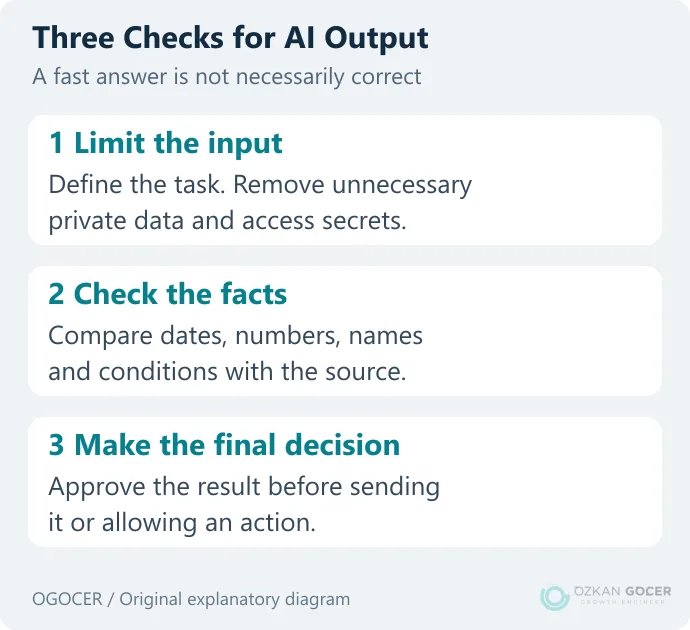
  • Always review the output: Verify every fact and number because models hallucinate and generate false information.
  • Learn the basics: Study basic machine learning (ML) logic using the resources below to build a long-term competitive advantage.

Further Resources

  • Wikipedia: Artificial Intelligence: The foundational database detailing the history, definitions, and academic sub-fields of the technology.
  • Google Machine Learning: Free educational guides and practical crash courses provided directly by Google developers.
  • Stanford HAI: Academic research focusing on human-centered systems and the annual industry data reports.
  • MIT: Technical papers and computer science research from the university laboratory.

In my own practice, I run daily experiments with neural networks to automate repetitive data sorting. Artificial intelligence functions by analyzing data patterns and applying those rules to new inputs. You now have the foundational knowledge regarding definitions, mechanics, types, and risks. Start practicing immediately. Run a generative tool on one specific task today, audit the output for errors, and measure the actual minutes saved.

FAQ

Frequently Asked Questions

Quick answers for readers who skipped to the end.

What is artificial intelligence?
Artificial intelligence (AI) is the general name for computer systems that imitate human intelligence to learn, reason, and make decisions. Unlike classic software, which follows hand-coded rules for every step, AI learns patterns from data. Machine learning, deep learning, and natural language processing are its sub-fields.
How does artificial intelligence work?
AI rests on three components: data, algorithms, and computing power. The system processes numerous examples, the algorithm finds patterns to build a model, and the model makes predictions on new data. If a prediction is wrong, the system learns from the error and corrects itself, creating a continuous learning loop.
What are 5 examples of artificial intelligence?
Five everyday examples include Google and Netflix recommendation systems, voice assistants like Siri and Google Assistant, face recognition on phone cameras, traffic prediction in navigation apps, and generative AI tools like ChatGPT. Such applications represent narrow AI.
Who invented artificial intelligence?
Computer scientist John McCarthy coined the term at the 1956 Dartmouth Conference. The foundations of the field rest on the "Turing Test" proposed by Alan Turing in 1950, which questioned whether machines can think.
What are the types of artificial intelligence?
Three types define AI capability: Narrow AI (ANI) excels at a single task and represents all AI in use today; General AI (AGI) would learn any topic like a human but does not yet exist; Super AI (ASI) would surpass human intelligence as a theoretical future scenario.
What is the difference between machine learning and AI?
AI serves as the broadest umbrella concept. Machine learning is a sub-field that learns from data, while deep learning is a neural-network-based subset of machine learning. While all machine learning is AI, not all AI is machine learning.
What is generative AI?
Generative AI goes beyond analyzing existing data to create new content, including text, images, audio, video, and code. ChatGPT and image generators represent this technology, which turned AI into a daily tool for millions of people after 2022.
What is artificial intelligence used for?
AI powers content creation, translation, image and speech recognition, recommendation systems, fraud detection, disease diagnosis, self-driving vehicles, and personalized marketing. The technology brings speed and efficiency to repetitive, data-heavy tasks.
Which industries use artificial intelligence?
Key applications include diagnosis and drug discovery in healthcare, fraud detection and credit scoring in finance, segmentation and ad optimization in marketing, quality control and predictive maintenance in manufacturing, personalized learning in education, and autonomous transport.
What are the advantages of artificial intelligence?
Primary advantages include speed and efficiency in repetitive work, rapid insights from big data, 24/7 uninterrupted operation, minimized human error, and personalized experiences. Proper implementation saves time and improves decision quality.
What are the risks of artificial intelligence?
The main risks include job losses through automation, data privacy concerns, algorithmic bias, misinformation, deepfakes, and a lack of accountability. Such issues stem primarily from how the technology is applied rather than the tool itself, making transparency and human oversight essential.
How do I start using artificial intelligence?
Starting does not require an engineering background. Begin by applying a generative AI tool to daily tasks like drafting emails or summarizing text. Focus on writing clear, context-rich prompts, select the appropriate tool for each task, and always review the output. Understanding basic machine learning concepts provides a strong advantage.
Summarize:
Özkan Göçer profile photo

Özkan Göçer

Growth Engineer & Digital Marketing Specialist

Özkan Göçer is a Growth Engineer and Digital Marketing Specialist with over 15 years of field experience and 200+ completed projects. He incorporates over 15 years of experience working with web technologies, modern development stacks, and digital infrastructures into this content.


Scroll to top