WHAT IS EMAİL MARKETİNG AND HOW IS IT DONE?

What Is Email Marketing and How Is It Done?

Email marketing generates sales, loyalty, and engagement by delivering updates, campaigns, and content directly to a permission-based subscriber list. Executed correctly, the channel produces the highest return on investment (ROI) in digital marketing, yielding an average of $35 to $40 for every $1 spent. Social media platforms restrict your organic reach through algorithms. Email bypasses these gatekeepers. You connect directly with an audience you own. Profitable campaigns require a permission-based list, smart segmentation, and high-value content.

In my own practice building email funnels and automation flows for brands for over seven years, I have watched campaigns double their open rates, while others collapsed from a single weak subject line. Skeptics often claim email marketing is dead. They are wrong. Owning your list makes email your most profitable channel. You will learn what email marketing is, how to set it up step by step, the campaign types, subject-line tactics, metrics, tools, and General Data Protection Regulation (GDPR) compliance, using real examples.

What Is Email Marketing?

In the projects I have managed, direct access to an audience consistently outperforms rented attention on social media. Acquiring opted-in subscribers gives you a direct line to build long-term trust, converting one-time readers into repeat buyers. Common formats include newsletters, campaign announcements, welcome series, and abandoned-cart reminders. Email represents your most valuable owned-media asset within your broader digital marketing strategy. It builds equity.

Why Is Email Marketing Important? (Benefits)

In the projects I have managed, relying solely on third-party networks always exposes businesses to sudden algorithm updates. Renting space on social media cannot compete with owning your distribution channel. Direct access to your audience secures your marketing asset.

  • Highest ROI: Every dollar spent on campaigns generates measurable revenue, beating organic search and paid ads.
  • An owned audience: You control the distribution channel, protecting your business from sudden platform policy changes.
  • Direct and personal: Segmented campaigns deliver specific solutions straight to the subscriber's inbox.
  • Measurable: Real-time analytics show exact open rates, click-through rates, and direct sales data.
  • Automation-friendly: Triggered sequences work in the background, converting leads while you focus on operations.

Email Marketing Types and Examples

In the projects I have managed, relying on a single message format kills conversion rates. You must match specific formats to distinct user actions. Mixing different formats guides subscribers from initial signup to the final purchase. Action drives revenue.

TypeGoalExample
Welcome SeriesEstablish trust and introduce the brand"Welcome! Here is your discount code"
NewsletterProvide consistent value and maintain brand recallWeekly tips or industry content roundups
Campaign / PromotionDrive immediate conversions and revenue"End of season: 40% off everything"
Abandoned CartReclaim abandoned revenue from incomplete checkouts"You left items in your cart!"
Re-engagementWin back inactive subscribers"We miss you; here is a special gift"

How to Set Up an Email Campaign Step by Step

In my own practice managing digital marketing campaigns, I execute a structured six-step process to maximize open rates and conversions.

  1. Set a goal: Establish whether your objective is direct sales, website traffic, or subscriber re-engagement. Your target dictates your copy.
  2. Prepare and segment your list: Categorize your subscribers based on behavior or demographics. Targeted messaging prevents unsubscribes.
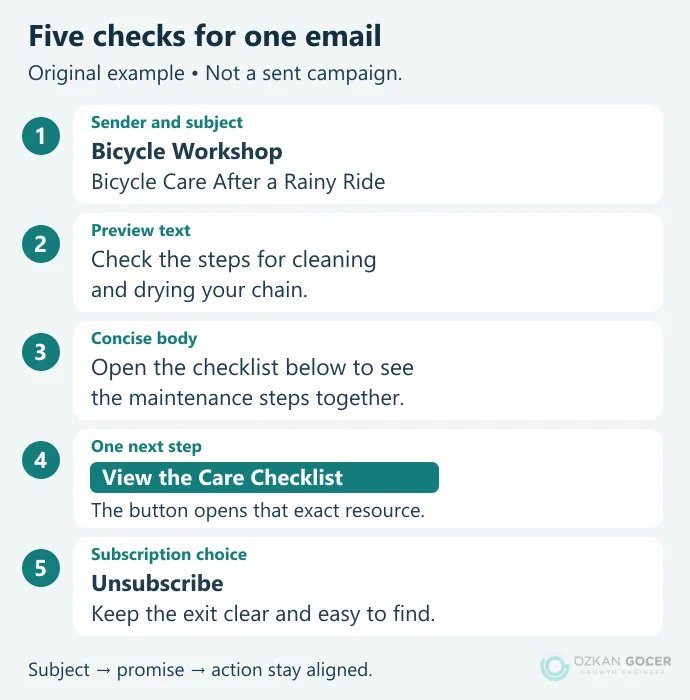
  3. Build content and design: Write concise copy around a single call to action (CTA). Use a responsive layout.
  4. Write the subject line: Create a hook that drives the open. Your subject line dictates whether your audience reads the email or deletes it.
  5. Test and send: Run A/B tests on subject lines and delivery times with a small segment. Optimize before emailing your entire database.
  6. Measure and improve: Track open rates, click-through rates, and conversions. Apply the data to refine your future marketing assets.

Building an Email List and Segmentation

In my own practice, I have seen purchased email lists destroy sender reputation instantly; organic growth remains the only viable path. You build a clean database by offering immediate utility through checklists, discounts, or e-books placed in strategic pop-ups and opt-in forms. Relevance beats volume. Grouping your subscribers by their actual purchase history, site behavior, or specific interests stops generic spam and increases conversion rates. Deploying a high-performing landing page design directly scales your daily sign-up volume.

Email Automation and Flows

In my own practice, I configure automated email sequences to trigger directly from user behavior, removing manual work from your daily operations. Your setup needs a welcome sequence for new signups, post-purchase thank-you messages with related product recommendations, abandoned-cart reminders, and win-back campaigns targeting inactive subscribers. Behavioral data drives every trigger. Once active, your system captures revenue around the clock. It works.

How to Write an Effective Subject Line

In my own practice managing email campaigns, I see users filter their inboxes in milliseconds. Your subject line dictates whether they click or delete. Apply my tested framework to increase your open rates:

  • Keep it short and clear: Limit the length to 40-50 characters to prevent mobile email clients from truncating your text.
  • Spark curiosity or highlight a benefit: Pose a specific question or state a clear value proposition immediately.
  • Personalize: Insert the recipient's first name or reference a past purchase to increase engagement.
  • Avoid spam triggers: Exclude aggressive sales terms like "free" or "you won" to keep your messages out of the junk folder.
  • Add urgency: Use deadlines to drive action, but apply this method selectively to avoid subscriber fatigue.

Email Marketing Metrics

Data dictates your next move. In my projects, I monitor specific indicators to evaluate campaign performance and spot delivery bottlenecks.

  • Open rate: Reveals subject line appeal and sender reputation.
  • Click-through rate (CTR): Indicates how well your copy and call to action drive action.
  • Conversion rate: Measures the percentage of recipients who complete your target action, such as a purchase.
  • Bounce rate: Flags undelivered messages to help you clean inactive addresses from your list.
  • Unsubscribe rate: Alerts you when content quality drops or sending frequency becomes annoying.

Evaluating email performance within a broader measuring success in digital marketing framework reveals how the channel drives actual revenue. Avoid looking at email in isolation.

Avoiding Spam and GDPR / Permission-Based Marketing

Data protection laws like the General Data Protection Regulation (GDPR) ban unsolicited commercial emails, making explicit consent a legal requirement for every campaign. In my own practice managing email campaigns, I have found that strict compliance is also your most effective defense against spam filters. Clean lists protect deliverability.

  • Secure explicit permission (opt-in): Build your audience through active, verifiable sign-ups and reject purchased databases.
  • Provide an easy exit: Place a visible, one-click unsubscribe link in the footer of every message.
  • Protect your sender reputation: Verify your sending domain and stick to a predictable broadcast schedule.
  • Avoid spam triggers: Write natural subject lines without all-caps text, deceptive hooks, or multiple exclamation points.
  • Keep your list clean: Remove inactive contacts, invalid addresses, and unengaged recipients on a regular basis.

Email Marketing Tools

Selecting the right platform automates your campaigns and tracks performance metrics directly. Most providers offer free starter tiers for small subscriber databases. You need a drag-and-drop editor, list segmentation, automation flows, A/B testing, and clear reporting dashboards. In my projects, I start with free tiers and upgrade only when subscriber growth justifies the cost. Scale takes time. If you run an online store, the setup logic I detailed in my entry into e-commerce article explains how to connect email automation with your shop database.

Disadvantages of Email Marketing

In my own practice, I see brands struggle with saturated inboxes and declining deliverability rates caused by unmaintained subscriber lists. Sending irrelevant content triggers immediate unsubscribes, while ignoring legal frameworks like General Data Protection Regulation (GDPR) results in heavy financial penalties. You can avoid failure. Build your list strictly on double opt-ins, send targeted messages, and maintain a steady broadcast schedule. Integrating your email strategy with online reputation management protects your sender score and brand authority.

Further Resources

  • Mailchimp Resources: provides foundational guides, email templates, and sector-specific performance benchmarks.
  • HubSpot Marketing Blog: offers tactical advice on campaign planning and marketing automation workflows.
  • Statista: delivers global data points on user adoption rates and ROI metrics.
  • Wikipedia: Email Marketing: documents the historical evolution and fundamental definitions of this marketing channel.

In the projects I have managed, sustainable growth always stems from permission-based lists rather than purchased databases. You must respect legal boundaries, master subject-line tactics, and select the right campaign types before sending. Start small. Build an attractive sign-up incentive, activate a single welcome automation, and send your first newsletter to measure your baseline open and click-through rates.

FAQ

Frequently Asked Questions

Quick answers for readers who skipped to the end.

What is email marketing?
Email marketing is the practice of driving sales, loyalty, and engagement by sending products, campaigns, or content to a permission-based subscriber list. Unlike social media, it allows you to reach an owned audience directly without algorithm interference, offering the highest ROI in digital marketing.
How is email marketing done?
The process involves six steps: setting a goal, preparing and segmenting a permission-based list, building content with a mobile-friendly design, writing a strong subject line, A/B testing, and measuring metrics for continuous improvement. A permission-based list and proper segmentation form the foundation of success.
What are the benefits of email marketing?
The main benefits include the highest return on investment (ROI), an owned audience independent of algorithms, direct and personal communication, clear measurability, and automation compatibility. Flows set up once can generate revenue continuously without manual effort.
What are examples of email marketing?
Common examples include a welcome series with a discount code for new subscribers, weekly newsletters, seasonal campaign announcements, abandoned-cart reminders, and re-engagement emails that revive dormant subscribers. An effective strategy blends these formats based on specific goals.
What are the types of email marketing?
The primary types include welcome series for relationship building, newsletters for regular value, promotional campaigns for direct sales, abandoned cart sequences to recover lost revenue, and re-engagement campaigns to revive dormant subscribers. Each type serves a different goal.
How do you build an email list?
Successful email lists are grown with permission rather than bought. You can use value-driven forms on your website, such as e-books, discounts, checklists, pop-ups, or dedicated sign-up fields. Optimized landing pages significantly raise sign-up rates. Segmenting the list by interest and behavior maximizes engagement.
How do you increase email open rate?
The subject line is key: keep it short and clear (40-50 characters), spark curiosity, offer a concrete benefit, personalize with the recipient's name, and avoid spam triggers. Maintaining a strong sender reputation, segmenting the list, and sending at optimal times further improve open rates. A/B testing helps identify the most effective approach.
What is email automation?
Email automation refers to sending pre-built emails automatically based on subscriber behavior. Welcome series, post-purchase thank-you notes, abandoned cart reminders, and re-engagement sequences represent the most valuable flows. It is set up once and runs 24/7 without manual effort.
Is it dangerous to give out your email address?
Giving your email to trusted, permission-based brands is safe; data-protection laws like GDPR require clear consent for every send and an easy unsubscribe option. Risks arise from unknown sources that send messages without consent. Always stay alert to spam and phishing emails.
How do you stop emails from landing in spam?
To prevent spam issues, use a permission-based (opt-in) list, include a visible unsubscribe link in every email, send consistently from a verified domain, avoid excessive capitalization or misleading subject lines, and regularly clean inactive addresses. Maintaining list health forms the foundation of strong deliverability.
What are the best email marketing tools?
Selecting the best tool depends on specific needs, though most platforms offer free starter plans for small lists. Essential features include a drag-and-drop template editor, segmentation, automation flows, A/B testing, and clear reporting. If you are starting out, begin with a free plan and scale as the list grows.
What is e-marketing, and how does it differ from email marketing?
E-marketing is the broad term for marketing activities conducted over the internet, including SEO, social media, advertising, and email. Email marketing is a sub-branch covering only the email channel. While all email marketing falls under e-marketing, e-marketing encompasses a much wider scope.
Summarize:
Özkan Göçer profile photo

Özkan Göçer

Growth Engineer & Digital Marketing Specialist

Özkan Göçer is a Growth Engineer and Digital Marketing Specialist with over 15 years of field experience and 200+ completed projects. He channels over 10 years of expertise in ROI optimization for Google Ads and Meta campaigns into this guide.


Scroll to top