
Imagine a bicycle repair shop whose videos attract views but few booking enquiries. Publishing more might help, but an unclear service area or a broken booking form could be the real obstacle. A workable plan follows the customer from first contact to the completed repair as far as the available evidence allows.
What Does Digital Marketing Include?
The term covers more than buying ads. A clear service page, visibility in search, a product demonstration and a customer newsletter can all contribute. The American Marketing Association’s definition encompasses a range of digital tools and channels.
Managing a social account is one part of the work. A digital marketing strategy explains why that account exists, how it connects with other channels and which business need it serves. Being present on every platform is not a requirement.
Match the Channel to the Customer’s Need
Scroll sideways to read every column. Keyboard: focus the table and use the arrow keys.
| Need | Possible starting point | First check |
|---|---|---|
| Reach someone already looking for a service | Search advertising and a relevant service page | Do the query, service area and page offer agree? |
| Be found by answering questions | SEO and useful content | Can people access the page, and does it answer the question? |
| Show how a product works | A demonstration video and social distribution | Can the viewer understand what to do next? |
| Maintain a relationship with subscribers | An expected email newsletter or appropriate reminder | Is it useful, and is unsubscribing straightforward? |
| Reach a particular community | A relevant publisher or creator partnership | Are the audience, commercial terms and measurement suitable? |
These are starting choices, not a universal channel ranking. Search may suit someone looking for a repair appointment; video may explain an unfamiliar maintenance product more clearly. Consider production time and your ability to respond to enquiries alongside audience size.
SEO and Search Advertising
SEO helps search engines access and understand pages while helping readers find useful answers. You do not pay Google an advertising charge for an organic click, but content, technical maintenance and staff time still have costs. Google’s SEO starter guide offers no top-ranking guarantee. For the writing itself, see how to structure useful search-friendly content and headings.
Google Ads provides access to paid advertising placements. Eligibility, competition, targeting and budget affect delivery; opening an account does not create sales. If this channel fits your goal, work through the checks for a first Google Search campaign. Advertising does not buy organic rankings.
Content, Social Media and Email
A maintenance demonstration can appear on the service page and in a social post, helping people at different points in their decision. Content planning and distribution give that work a purpose. Deciding who answers comments and messages belongs to the operational side of social media management.
Email can provide relevant material to subscribers who expect to hear from you. Having a list does not guarantee inbox delivery. Think about why someone would subscribe and how often they expect contact, rather than buying addresses. Video, influencer and affiliate work also need explicit responsibilities, content requirements and payment terms; these arrangements do not all charge only when a sale occurs.
Build a Practical Digital Marketing Plan
The bicycle repair example below is illustrative, not a client project or a reported result. A plan that fits on one page is easier to share, implement and revise.
- State a business objective. Replace “more visibility” with a traceable aim, such as receiving repair booking enquiries from people in the service area. Define which enquiries qualify.
- Collect questions people ask before booking. Which bicycles do you accept, what does the service cover and how does drop-off work? Search queries and genuine customer questions can inform the list.
- Complete the offer on the page. Explain the scope, location, contact method and response process. If you cannot quote a fixed price, explain what information a quote requires.
- Choose a main channel. A page that answers local demand and a narrowly scoped Search campaign could be a starting point. Add another channel when you can sustain the production and response workload.
- Assign measurement and ownership. Keep successful form submissions, qualified enquiries and completed jobs distinct. Someone at the business should record whether an enquiry was suitable.
- Set a review date. Examine spend, search terms, enquiries and business outcomes together. Record what changed and why; small counts can fluctuate without establishing a trend.
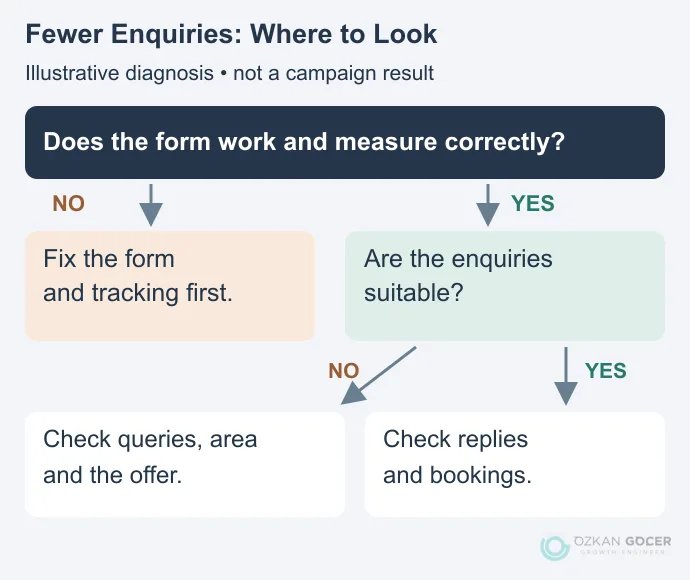
If enquiries arrive but repairs are not booked, changing the ad copy may be premature. Check response delays, service expectations and location mismatch. If clicks rise while enquiries fall, first verify that the measurement and form still work.
Which Measures Show Progress?
Different numbers answer different questions. Impressions describe exposure, clicks show interest in a link, and valid enquiries indicate a further action. Completed work or sales need confirmation in business records. Counting every phone-button click as a new customer can make a campaign look more successful than it is.
Scroll sideways to read every column. Keyboard: focus the table and use the arrow keys.
| Measure | Calculation or use | Limit |
|---|---|---|
| Click-through rate / CTR | Clicks ÷ impressions × 100 | A high rate does not prove sales or profit. |
| Advertising cost per valid enquiry | Ad spend ÷ valid enquiries | Keep the definition and period consistent; a zero-enquiry denominator gives no calculable rate. |
| ROAS | Revenue attributed to ads ÷ ad spend | It excludes product costs, refunds and other expenses, so it is not profit. |
| Qualified enquiries and completed jobs | Business or CRM records | These may not match web analytics one for one. |
Use ROAS, ROI and customer acquisition cost together when assessing the financial outcome. Examine organic search queries and visibility in Search Console, and measurable on-site behavior in web analytics. Consent choices, blockers, multiple devices and offline purchases mean that no single report captures every customer journey.
A useful report ends with a decision. For example: “Separate out-of-area enquiries and review location targeting.” For social channels, the reporting method with explicit sources and comparison periods helps turn observations into a specific next action.
What Does a Digital Marketing Specialist Do?
A specialist researches audiences and queries, plans channels, coordinates content or advertising, checks measurement and recommends changes. A small business may combine those tasks in one role; a larger team may separate SEO, paid media, content and analytics. The title does not automatically require one person to be a developer, designer and sales representative.
To start learning, create a small project file: a business need, audience, sample page, channel rationale and measurement plan. If you have not run a campaign, label the work as a proposed plan. Invented customer results or dashboard screenshots do not make a credible portfolio.
Google Skillshop’s Ads learning resources can help you study the platform. A certificate alone does not demonstrate every practical skill. Salaries and freelance income depend on location, experience, scope and employment arrangements; a single figure without current, comparable market data would mislead.
Where Can AI Help?
AI can help group topics, draft copy options or look for inconsistencies in a report. It does not automatically know how a product works, what a customer experienced or whether tracking is configured correctly. Check factual claims against sources and offers against real business conditions. Avoid putting personal or confidential information into tools without an appropriate basis.
Choose one offer and write down its objective, page, channel and measurement path. The missing step often becomes easier to identify. If you want outside support with paid advertising, assess the scope of Google Ads management against those objectives and responsibilities.