WHAT İS ETHEREUM? THE TECHNOLOGY THAT STARTED THE DEFİ AND NFT REVOLUTİON

What is Ethereum? The Technology That Started the DeFi and NFT Revolution

Ethereum is a decentralized blockchain platform on which smart contracts and applications can run. Below you will find what Ethereum is for, how it differs from Ether (ETH), what a smart contract is, who it belongs to, how it differs from Bitcoin, the Proof of Stake transition, and how ETH is bought.

What Is Ethereum, What Is It For?

Ethereum is an open-source, decentralized blockchain platform that went live in 2015. The most important feature that sets it apart from Bitcoin is this: while Bitcoin is mainly a digital money and value transfer system, Ethereum is beyond that a programmable network; smart contracts and decentralized applications (dApps) can run on it.

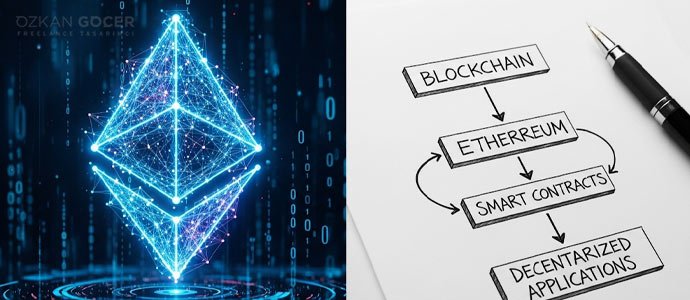
You can think of Ethereum not just as money but as a "world computer" on which applications can be built. What is it for? Decentralized finance (DeFi), NFTs, games, identity and many more applications are built on Ethereum's infrastructure. Ethereum's own cryptocurrency is called "Ether" (symbol ETH) and is used to run transactions on the network. You can examine the technical side on its official site and in my blockchain article.

Are Ethereum and Ether (ETH) the Same Thing?

The most confused point is this; let us clarify. Ethereum is the name of the platform and network; it is the blockchain system on which applications run. Ether (abbreviated ETH) is this platform's own cryptocurrency. So Ethereum is the "system", and Ether is that system's "fuel and money".

Although in everyday language people mostly say "I bought Ethereum", what they actually buy is the Ether (ETH) coin. What is Ether for? The fee for transacting on the Ethereum network (called "gas") is paid with Ether; running smart contracts and applications also requires Ether. What you see priced on an exchange and what is bought and sold is Ether; Ethereum is the name of the platform on which this money moves. The two are intertwined but not the same thing.

What Is a Smart Contract?

A smart contract is the concept that makes Ethereum special. Although it is called a "contract", it is actually a computer program that runs on the blockchain and executes by itself when certain conditions are met. Its logic rests on the "if-then" rule: when the set conditions are satisfied, the contract carries out the transaction automatically without needing an intermediary.

A simple analogy: think of a vending machine; when you insert money and press a button, the product drops automatically without needing a cashier. Smart contracts also work without intermediaries, automatically and unchangeably; once the rules are written to the blockchain, they are transparent. So decentralized applications can be built on Ethereum: intermediary-free lending platforms, swap systems, NFT markets and games. Smart contracts are the basis for Ethereum being "not just money but a programmable platform"; that said, a poorly coded contract can also pose a risk.

Who Owns Ethereum, Which Country Is It From?

Ethereum does not belong to any country or a single person; it is a decentralized project. It is not under the control of a state, bank or company; it is run by a distributed network made up of computers (nodes) around the world.

So who created it? The idea of Ethereum was put forward by the programmer Vitalik Buterin; he wrote the concept in 2013 and brought the network to life in 2015 with a few co-founders. Its development is supported by the non-profit Ethereum Foundation and a broad open-source community; you can also read its history in encyclopedic sources. Still, this does not mean Buterin "owns" Ethereum; he is the person who started it, but the network is no one's monopoly and decisions are shaped by the community.

The Difference Between Bitcoin and Ethereum

Both are major cryptocurrencies but their purposes differ:

  • Bitcoin: the first and largest cryptocurrency; its main purpose is to be a decentralized digital money and store of value ("digital gold").
  • Ethereum: not just money but a platform on which smart contracts and applications can run.
  • Energy: Bitcoin uses energy-intensive "Proof of Work" mining; Ethereum moved to "Proof of Stake" in 2022 and greatly reduced its energy use.
  • Supply: Bitcoin has a fixed cap (21 million); Ethereum's supply model is different.

In short, Bitcoin can be thought of as "digital money and value", and Ethereum as "an application platform and its own money". Rather than rivals, the two are major projects serving different functions. What I write is not investment advice.

Ethereum 2.0 and the Move to Proof of Stake

Ethereum went through the biggest technical change in its history with the "The Merge" update in 2022, moving from the energy-consuming "Proof of Work" system to the "Proof of Stake" system; it is also popularly called "Ethereum 2.0". The difference in short: in Proof of Work (the method Bitcoin still uses), miners compete by spending great computing power and electricity to verify transactions.

In Proof of Stake, those who verify transactions (validators) take on this task by "locking" (staking) a certain amount of Ether in the network; the winner is not the one spending energy but the one putting up a stake and acting honestly. The biggest benefit of the transition was that it cut Ethereum's energy use by about 99 percent and greatly eased environmental criticism. The structure also brought the concept of "staking" (earning rewards by locking Ether) to the fore; I covered the technical side on ethereum.org and the practical side in my staking article. Staking has its own risks too and is not recommended here.

How Is Ether (ETH) Bought, Why Does Its Price Keep Changing?

Ether (ETH) is bought and sold through cryptocurrency exchanges. The general steps are: sign up to a reliable and legal exchange (in Turkey registered with MASAK and subject to SPK regulation) and complete identity verification; deposit money into your account; buy Ether from the exchange; if you wish, keep your Ether on the exchange or withdraw it to your own wallet (never share your recovery phrase).

Why does its price keep changing? Because Ether's price, like other cryptos, is set by supply and demand in markets open 24/7 and is extremely volatile; news, market sentiment, Bitcoin's movement, regulations and big investor transactions can change the price within minutes. The question "how much is 1 ETH" has no fixed answer; you can only see the live price currently from a market source. A reminder: crypto prices can fall fast just as they rise fast; you can lose part or all of the money you invest. What I write is not investment advice.

FAQ

Frequently Asked Questions

Quick answers for readers who skipped to the end.

What is Ethereum, what is it for?
Ethereum is an open-source, decentralized BLOCKCHAIN PLATFORM that went live in 2015. The most important feature that sets it apart from Bitcoin is this: while Bitcoin is mainly a digital money or value transfer system, Ethereum is beyond that a "programmable" network; "smart contracts" and decentralized applications (dApps) can run on it. So you can think of Ethereum not just as money but as a "world computer" on which applications can be built. What is it for? Decentralized finance (DeFi: intermediary-free lending, swapping), NFTs, games, identity and many more applications are built on Ethereum's infrastructure. Ethereum's own cryptocurrency is called "Ether" (symbol ETH) and is used to run transactions on the network. In short, Ethereum is one of the largest platforms in the crypto world and the one hosting the most applications. This content is informational, not investment advice.
Are Ethereum and Ether (ETH) the same thing?
No, and this is the most confused point; let us clarify: ETHEREUM is the name of the platform or network (the blockchain system on which applications run). ETHER (abbreviated ETH) is this platform's own cryptocurrency. So Ethereum is the "system", and Ether is that system's "fuel or money". Although in everyday language people mostly say "I bought Ethereum", what they actually buy is the Ether (ETH) coin. What is Ether for? The fee for transacting on the Ethereum network (called "gas") is paid with Ether; running smart contracts and applications also requires Ether. So Ether is the lifeblood of the Ethereum ecosystem. Summary: what you see priced on an exchange and what is bought and sold is Ether (ETH); Ethereum is the name of the huge platform on which this money moves. The two are intertwined but not the same thing.
What is a smart contract?
A smart contract is the concept that makes Ethereum special. Although it is called a "contract", it is actually a computer program that runs on the blockchain and executes BY ITSELF when certain conditions are met. Its logic rests on the "if-then" rule: when the set conditions are satisfied, the contract carries out the transaction automatically without needing an intermediary. An analogy: think of a vending machine; when you insert money and press a button, the product drops automatically without needing a cashier. Smart contracts also work without intermediaries, automatically and unchangeably; once the rules are written to the blockchain, they are transparent and do not require trusting the parties (you trust the system). This lets decentralized applications be built on Ethereum: intermediary-free lending platforms, swap systems, NFT markets, games and more. Smart contracts are the basis for Ethereum being "not just money but a programmable platform"; this is its biggest difference from Bitcoin. Note: poorly coded or exploited smart contracts can also pose a risk.
Who owns Ethereum, which country is it from?
Ethereum does NOT belong to any country or a single person or company; it is a decentralized project. That is, it is not in the ownership or control of a state, bank or company; it is run by a distributed network made up of computers (nodes) around the world. So who created it? The idea of Ethereum was put forward by the Russian-born Canadian programmer VITALIK BUTERIN; he wrote the concept in 2013 and brought the network to life in 2015 with a few co-founders. Its development is supported by a non-profit organization, the Ethereum Foundation, and a broad open-source developer community. But this does not mean Vitalik Buterin "owns" Ethereum; he is the person who started it, but the network is no one's monopoly and decisions are shaped by the community or developers. In short: Ethereum has no owner and does not belong to a country; Vitalik Buterin is the person who created it, and it is sustained by a decentralized community.
What is the difference between Bitcoin and Ethereum?
Both are major cryptocurrencies but their PURPOSES differ: (1) BITCOIN is the first and largest cryptocurrency; its main purpose is to be a decentralized DIGITAL MONEY or store of value (the "digital gold" analogy). It is mainly built on value transfer and storage. (2) ETHEREUM goes a step further; not just money but a PLATFORM on which SMART CONTRACTS and applications can run. So if Bitcoin is "money", Ethereum is like "a programmable computer on which money also runs". Other differences: Ethereum's transaction times and flexibility differ; also, while Bitcoin uses energy-intensive "Proof of Work" mining, Ethereum moved to "Proof of Stake" in 2022 and greatly reduced its energy use. In terms of supply, Bitcoin has a fixed cap (21 million), while Ethereum's supply model is different. Summary: Bitcoin equals digital money or value; Ethereum equals an application platform plus its own money (Ether). Rather than rivals, the two are major projects serving different functions. This is general information, not investment advice.
What are Ethereum 2.0 and Proof of Stake?
Ethereum went through the biggest technical change in its history with the update called "The Merge" in 2022, moving from the energy-consuming "Proof of Work" system to the "Proof of Stake" system. This is also popularly called "Ethereum 2.0". The difference in short: in PROOF OF WORK (the method Bitcoin still uses), "miners" compete by spending great computing power and electricity to verify transactions. In PROOF OF STAKE, those who verify transactions ("validators") take on this task by "locking" (staking) a certain amount of Ether in the network; the winner is not the one spending energy but the one putting up a stake and acting honestly. The biggest benefit of this transition was that it greatly REDUCED Ethereum's energy use (by about 99 percent); this significantly eased environmental criticism. The structure also brought the concept of "staking" (a reward for contributing to the network by locking Ether) to the fore. This is technical information; staking and similar activities have their own risks and are not recommended here.
How is Ether (ETH) bought, why does its price keep changing?
Ether (ETH) is bought and sold through cryptocurrency exchanges. The general steps: (1) Sign up to a reliable and legal crypto exchange (in Turkey registered with MASAK and subject to SPK regulation) and complete identity verification. (2) Deposit money into your account. (3) Buy Ether (ETH) from the exchange. (4) If you wish, you can keep your Ether on the exchange or withdraw it to your own crypto wallet (never share your recovery phrase in your own wallet). Why does its price keep changing? Because Ether's price, just like other cryptos, is set by SUPPLY and DEMAND in markets open 24/7 and is extremely VOLATILE: news, market sentiment, Bitcoin's movement, regulations and big investor transactions can change the price seriously within minutes. So the question "how much is 1 ETH" has no fixed answer; you can only see the live price currently from an exchange. IMPORTANT: crypto prices can fall fast just as they rise fast; you can lose part or all of the money you invest. This content is not investment advice; understand the risks well before deciding.
Summarize:
Özkan Göçer profile photo

Özkan Göçer

Growth Engineer & Digital Marketing Specialist

Özkan Göçer is a Growth Engineer and Digital Marketing Specialist with over 15 years of field experience and 200+ completed projects. He infuses this analysis with over 7 years of expertise in blockchain, crypto markets, and Web3 marketing.


Scroll to top