
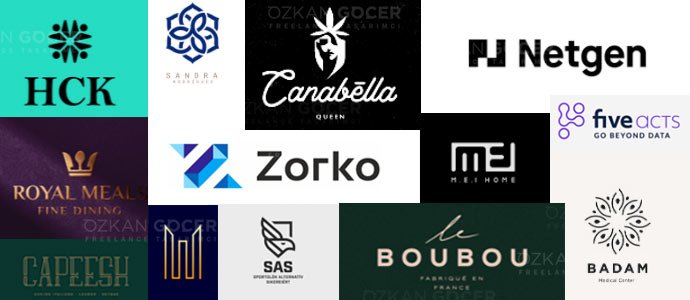
4 Ways to Get a Logo: Overview
There are four main ways to get a logo for your brand, and which fits depends on your budget, time, and how serious your need is. With DIY, you design it yourself using Canva or online logo tools (cheapest and fastest, but limited and generic results). With AI generators, you enter your info and AI produces logo options (fast and cheap, but originality and quality vary).
With a freelancer, you work with a freelance graphic designer (mid-budget, personalized result); with an agency, you work with a professional design or branding agency (highest budget, the most comprehensive and professional brand identity). In short, for a small side project or a temporary logo, DIY or AI may be enough, but for a serious, long-lasting logo that represents your brand, working with a freelancer or agency is more appropriate; a logo is your brand's face for years, and the investment usually pays off. I gathered the qualities of a good logo in my logo designer article.
1. DIY: Canva and Online Logo Makers
If you want to make your own logo without a designer, there are user-friendly tools. Canva is one of the most popular and easy options; its drag-and-drop interface and ready templates let you create a logo without design knowledge (it has a free tier). Online logo makers like Looka, Turbologo, and Wix Logo Maker ask a few questions and generate ready options, and they usually run in your browser with no software to install.
The DIY steps go like this: clarify your brand and target audience, get inspiration from logos you like (without copying), try a simple, clean design in a tool (do not overcomplicate), choose colors and fonts that fit your brand identity, and check how it looks at different sizes. The upside is that it is cheap or free and fast; the downside is that results often look templated, can resemble other brands, and may not be truly original. It is practical for a small or new business, but for a logo that seriously represents your brand, consider professional help.
2. AI Logo Generators (Can ChatGPT Design a Logo?)
AI logo generators have become a popular fast option: you enter your business name, industry, and preferences, and AI produces many logo options. Can ChatGPT design a logo? To a degree, yes; AI image tools (including those integrated with ChatGPT) can generate logo-style images from a text prompt, and dedicated AI logo makers can produce polished-looking options quickly.
The pros are speed (dozens of options in minutes), a cheap or free start, and usefulness for inspiration. But there are caveats to check: AI logos often use similar patterns and can resemble other brands, so they may not be truly distinctive; the commercial-use and ownership terms for AI-generated logos can be unclear, so always read the terms of use; check whether you get a scalable vector file (SVG or AI); and AI cannot understand your brand's essence and story like a human designer. The bottom line is that AI logos are fine for a quick or temporary need, but limited for a serious, long-lasting brand logo.
3-4. Hiring a Freelancer or Agency
For a professional, original logo, working with a designer or agency is the most reliable. With a freelancer, you work with an independent graphic or logo designer; the upside is usually a more affordable price than an agency, direct communication, and a personalized result. You can find freelancers on platforms (Fiverr, Upwork, 99designs), in design communities (Behance, Dribbble), or through referrals; when choosing, look at their portfolio, because past logos show their style and quality. I explained the freelance model in detail in my freelancer article.
With an agency, you work with a professional design or branding agency; the upside is the most comprehensive, professional service, because it offers not just a logo but often a complete brand identity (color palette, typography, usage guidelines), with a team and process, while the downside is the highest cost. The process runs like this: you provide a brief explaining your needs and brand, the designer presents concepts and sketches, it is revised with your feedback, and the final logo is delivered in various file formats. If your budget is limited and one quality logo is enough, a freelancer; if you want a comprehensive corporate brand identity, an agency makes sense; in all cases, reviewing past work is the most important step. To find a professional logo designer, freelance platforms are a good start.
How to Write a Good Logo Brief
The secret to a great logo is often a great brief (the instructions and info you give the designer). The designer does not know your brand as well as you do; the clearer your information, the better the result. A good brief should include these:
- Your brand: what you do, your story, your values, and what sets you apart from competitors.
- Target audience: who you serve (age, style, expectations).
- Brand personality and tone: how your brand should feel (modern vs. classic, serious vs. playful, luxury vs. friendly).
- Examples: logos you love (and why), ones you dislike, and competitor logos.
- Use and files: where it will be used (web, signage, products, social media), the file formats you need (including vector), budget, and timeline.
A tip: rather than telling the designer "draw exactly this," describe your brand's essence and feel and give them creative room; a professional, with the right info, can produce strong solutions you would not have thought of. A clear brief reduces revisions and gets you a logo much closer to what you want.
How Much Does a Logo Cost? (And the 7 Rules of Design)
Getting a logo designed varies widely by method and scope. DIY (Canva and tools) is free or very low cost (some tools charge a small fee for high resolution); AI generators are usually free to try with a low-to-mid fee for downloads; a freelancer's price varies by experience and scope and rises significantly from a beginner to a renowned designer; and an agency is the highest range, since it usually includes a complete brand identity and professional process. The factors that set the price are whether you want just a logo or a broad brand identity (color, typography, and guide included), the number of revisions, the file formats delivered, and the designer's or agency's reputation.
So there is no single figure; the healthy approach is to clarify your needs (scope, uses, file formats) and get quotes from a few designers or agencies, comparing what is included in writing. The "7 rules of design" that good logos respect are commonly cited as balance, contrast, alignment, proximity (grouping related elements), repetition or consistency, hierarchy (emphasizing what matters most), and white space (using emptiness purposefully). For logos specifically, designers also stress being simple, memorable, original, timeless, versatile, and appropriate to the brand. Whether you DIY or hire a pro, keeping these principles in mind, especially simplicity, helps you recognize and request a strong logo.
Risks of Free and AI Logos
Free or AI-generated logos can be tempting, but they carry risks worth knowing. The originality problem comes first: free templates and AI generators use similar patterns, so a logo you think is unique may be used by many other businesses or closely resemble them, which hurts your brand's distinctiveness. On ownership and rights, some tools' terms may restrict commercial use or not grant you full ownership, so always read the license terms; you could also unknowingly end up with a logo similar to someone else's copyrighted element.
File format and quality matter too: free tools often do not provide a scalable vector file (SVG or AI), and if you only get a low-resolution image (PNG or JPG), your logo will distort at large sizes like signage and print; I explained the vector format logic in my file formats article. A ready or AI logo may not reflect your brand's essence, and support and revisions can be limited. The bottom line is that free or AI logos are practical for small, temporary, or no-budget starts, but for a serious brand, originality, ownership safety, and vector quality are essential; whichever route you choose, at minimum make sure your logo is original, owned by you, and vector. Professional tools like Adobe Illustrator can help with vector output.


