Where do I find the transaction ID?
Open the sending wallet’s activity or the exchange’s withdrawal history and select the individual transfer. Look for “transaction hash,” “transaction ID” or “view on explorer.” An order number or withdrawal reference may be meaningful only to that provider’s support team.
An address identifies an account or destination. A transaction ID identifies a particular operation. Search an address and you may see two payments for the same amount. Copy the complete ID from the sending record instead of guessing which payment is yours or pasting a shortened string from a screenshot.
Choose the explorer for the sending network
A Bitcoin mainnet transaction belongs in a Bitcoin mainnet explorer. An asset such as USDT exists on several networks, so the ticker alone cannot tell you which explorer to open. Some networks also share an address format. Check the network name on the withdrawal itself.
Follow the link in your wallet's activity view or one supplied by the network documentation. Ethereum’s explorer guide explains the fields you will see. Looking up a public transaction requires no wallet signature, recovery phrase or deposit.
Does a block number mean it worked?
On November 9, 2026, I opened this existing Sepolia testnet transaction. Its details showed block 12,096,832 and Fail. Further down the page, the explorer reported a reverted contract call. The network had included the transaction, but the intended token transfer had not gone through.
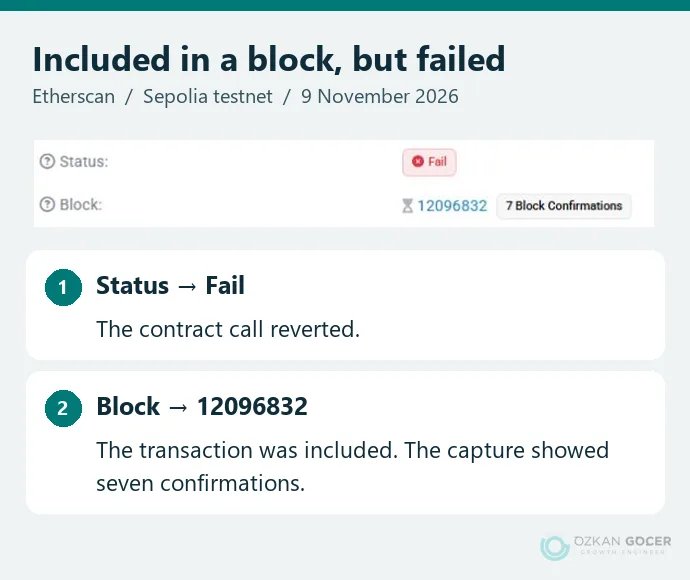
The same record showed a transaction fee. Executing a contract consumes gas even when the call ultimately reverts. The confirmation count changes as new blocks arrive. More confirmations for this record would not turn the failed call into a successful payment. You can open the testnet record yourself and compare the two fields.
What to do with each status
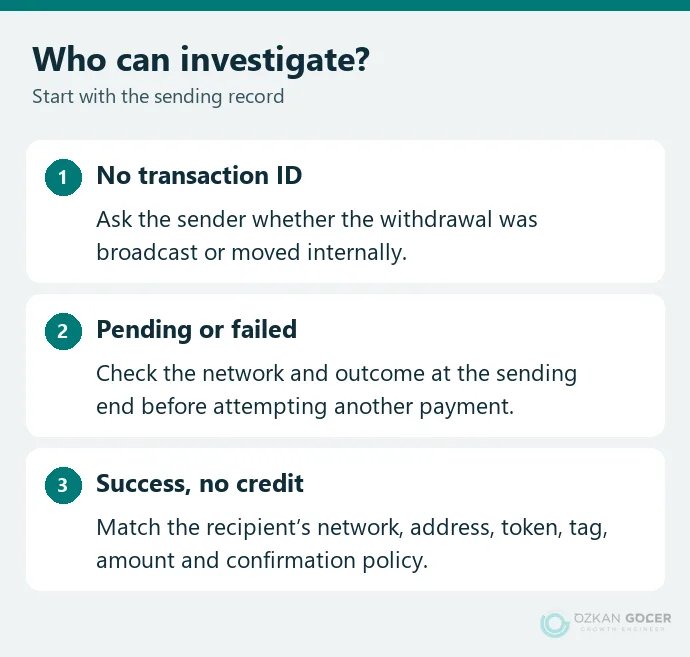
Not found. Check the full ID and network first. The sender may have created a withdrawal request without broadcasting a transaction, or the explorer may not have indexed it yet. A transfer between users on the same service can also be internal. Ask the sender about broadcast status before making a second payment.
Pending. The explorer knows about the transaction but does not yet show an included result. The receiving exchange may have nothing to credit at this stage. With a custodial withdrawal, decisions about replacement or network fees may belong to the sending service.
Failed. Save the result and error message. Review the network fee and your asset balance separately at the sending end. Understand why the attempt failed before considering another one.
Success. Identify what succeeded. For a native coin payment, compare the recipient and value. For an ERC-20 transfer, the top-level “To” field can be a token contract. Inspect the token transfer entries for the contract, recipient and amount. A successful token approval alone does not transfer the asset.
Why has a successful deposit not been credited?
Compare the receiving service’s deposit instructions with the actual asset, network, address, minimum amount and required confirmations. Some deposits also need a memo or an XRP destination tag. The receiving service keeps its own customer accounts. Its internal credit cannot be confirmed just by reading the chain. Kraken’s deposit timing guide shows how requirements vary by asset and network. Use the rules of your actual receiving service.
For Bitcoin, a transaction gains its first confirmation when it enters a block, then gains confirmations as blocks are added on top. The Bitcoin developer guide explains the count. Other networks use different finality mechanisms. If you used a bridge, look up its progress record as well. The source and destination networks may have separate transaction IDs.
Who can investigate the missing transfer?
If the request is under review with no TXID, start with the sending platform. For Turkish exchange withdrawal rules, see the separate guide to platform waiting periods. If the correct transfer reached a supported deposit address and the receiving conditions are met, contact the receiving service. For self-custody, first open the correct account and network and check token visibility. The wallet setup and network guide covers those controls.
Use the official support channel. Include the network, asset, net amount, time with time zone, transaction hash and any required deposit tag. A public hash can reveal links between addresses, so a private ticket is preferable to a public post. The receiver can assess a wrong-network transfer or missing tag. No recovery agent needs your secret phrase or a signature to inspect a transaction.