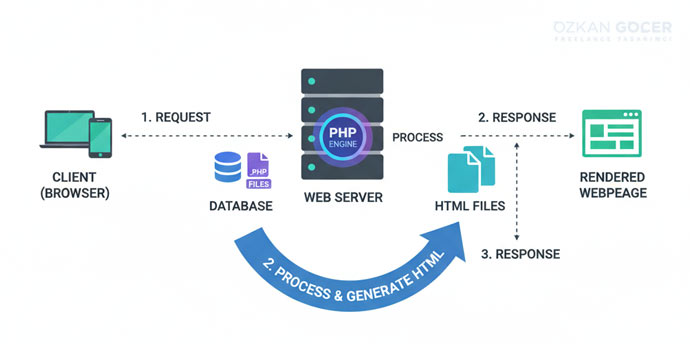
What Is PHP and Why Is It So Widely Used?
PHP is an open-source programming language used primarily for building the server side (back end) of websites. Server-side languages like PHP make a web page dynamic: content that changes per user, form processing, pulling data from a database, login or membership, and more. PHP has been one of the most common web-development languages since the early days of the internet; its official home is php.net.
Why is it so widely used? Because it is relatively easy to learn, completely free and open source, supported out of the box on nearly every web host, pairs very well with databases like MySQL, and has a massive ecosystem and community. Most importantly, WordPress, the world's most-used content management system, is built in PHP. Together, these factors make PHP an easy, cheap, and ubiquitous choice, especially for websites and web applications; the sections below break down each reason. Knowing HTML5 frameworks helps on the modern interface side too.
The Reasons PHP Is So Popular
Several strong reasons drive PHP's popularity:
- Easy to learn: relatively simple syntax; beginners can get into web development quickly.
- Free and open source: no cost to use, lowering the barrier for individuals and companies.
- Supported everywhere: nearly all web hosts support PHP out of the box, so deploying a site is very easy.
- Database compatibility: it works especially well with MySQL; the "PHP + MySQL" duo is a classic foundation of the web.
- Huge ecosystem: WordPress, Laravel, ready-made libraries, and countless plugins.
- Large community: abundant resources and documentation; when you hit a problem, a solution is usually findable online.
All of this makes PHP practical, accessible, and low-cost, especially for web projects, which is the foundation of its popularity. The language is platform-independent too, running on Windows, Linux, and more. You can find a comparison with another established language, Java, in my Java developer article.
The WordPress Factor: PHP Powers a Huge Share of the Web
Perhaps the single biggest reason for PHP's prevalence is WordPress. WordPress is the world's most-used content management system (CMS), and a very large share of all websites are built on it; WordPress is written entirely in PHP. That means a huge portion of the web runs on PHP behind the scenes. You can see the official project at wordpress.org.
Millions of people building blogs, business sites, news sites, or small-business sites use WordPress, which creates constant, massive demand for PHP. Beyond WordPress, other popular CMSs like Joomla and Drupal, plus powerful modern PHP frameworks like Laravel, feed this ecosystem too. For anyone in web development or site-building, knowing PHP remains a very practical advantage, because a large share of existing sites depends on it. The WordPress factor also answers the "is PHP dead?" debate clearly: while such a large portion of the web runs on PHP, it is not going away anytime soon.
What Is PHP Used For? (Frontend or Backend?)
PHP is a back-end (server-side) language, not a frontend language. The frontend (what users see in the browser) is built with HTML, CSS, and JavaScript, while PHP runs on the server and handles what happens behind the scenes. What PHP is used for: dynamic websites (sites that change per user and connect to databases, with membership, login, content management); content management systems (the foundation of WordPress, Joomla, Drupal); e-commerce (WooCommerce and Magento are PHP-based); web applications and APIs (professional apps, admin panels, and REST APIs via frameworks like Laravel or Symfony); form processing (contact forms, surveys); and blogs and corporate sites.
So when a user clicks a button or submits a form, the part doing the work on the server is often PHP. Outside the web, PHP is used less; Python, for example, is preferred for data science. PHP's natural strength is web development; browser-side interactivity comes from JavaScript libraries, while the server side is often handled by PHP.
Is PHP Outdated in 2026?
Honest answer: no. Despite occasional "PHP is dead" claims, PHP is still very widely used and will remain so for the foreseeable future. The clearest proof is that a very large share of all websites (largely thanks to WordPress) still run on PHP. PHP also keeps improving: modern versions (PHP 8 and later) are far better in performance and features than older ones, and modern frameworks like Laravel keep PHP strong for professional projects. You can see web usage shares in sources like W3Techs.
To be balanced, though: PHP is not the only option. JavaScript (Node.js), Python, and other languages are also strong for web back ends, and some new projects choose those alternatives. So PHP is not the "only" choice, but it remains very valid with plentiful job opportunities, especially if you will work with WordPress or existing PHP-based systems. Bottom line: learning PHP still makes sense; it is a mature, widespread language, not a dead one, and it remains one of the gateways into web development for beginners.
PHP vs JavaScript (and PHP vs HTML)
The comparisons are common, so let me clarify both. PHP versus HTML is a bit of a misframing, because they are not competitors and do different jobs: HTML is a markup language that structures the content of a page (the frontend skeleton), while PHP is a programming language that runs on the server to generate dynamic content. In fact, PHP and HTML are often used together, with PHP generating the HTML that gets sent to the browser. So HTML structures, and PHP processes.
PHP versus JavaScript is a real comparison, but classically they live in different places: JavaScript runs in the browser (frontend) to make pages interactive, while PHP runs on the server (backend). However, JavaScript can also run on the server now (via Node.js), making it a backend competitor to PHP. Which to choose? PHP is great for web back ends (especially WordPress and many CMSs); JavaScript lets you use one language across frontend and backend and dominates frontend work. Many developers learn both, and the "best" choice depends on the project and your goals, not a universal winner.
Will AI Replace PHP Developers?
The realistic answer: AI is more likely to change the work of PHP developers than to replace them outright. AI coding tools can speed up writing, debugging, and reviewing PHP code, handle repetitive tasks, and generate boilerplate, which makes developers more productive. But building real software still requires human judgment: understanding requirements, designing systems, making architectural decisions, ensuring security, integrating with complex existing systems, and verifying that AI-generated code is correct and safe.
AI can produce wrong or insecure code, so a knowledgeable developer is needed to guide, review, and fix it. So rather than "replacing" PHP developers, AI shifts the role toward higher-level work (design, oversight, problem-solving) while automating some routine coding. The developers who thrive will be those who use AI as a productivity tool while bringing the expertise AI lacks. In short, AI is a powerful assistant, not a replacement, and learning to work alongside it is the smart move.