What Is PHP and What Does It Stand For?
PHP is a server-side programming language used to develop websites. It is widely used to build dynamic websites and web applications in particular. Its name today stands for "PHP: Hypertext Preprocessor"; this is a recursive abbreviation that refers to itself. When it first appeared, it meant "Personal Home Page".
PHP appeared in the mid-1990s and played a big role in the web's development; today it still lies at the foundation of many websites, especially WordPress. In short, PHP is a web-focused programming language that lets web pages be generated dynamically on the server. For the official source and documentation, php.net is the first place to turn. (The "PHP" abbreviation also has different meanings in fields like medicine and currency; I touch on these at the end.)
What Is PHP For? What Can Be Built?
PHP is mainly used to build dynamic websites and web applications. Most of the work that lets a website think in the background, work with data and serve personalized content can be done with PHP.
- Dynamic content: generating pages that change by user and situation.
- Form processing: taking and processing data from contact, membership and login forms.
- Database operations: saving, reading and updating data with databases like MySQL.
- Content management systems: WordPress, Joomla and Drupal are built on PHP.
- E-commerce and membership/login management.
A significant part of the sites on the internet still use PHP, which makes it an important language in web development. That breadth of use also keeps it practical in real projects, since hosting, documentation and community support are easy to find for almost any PHP stack.
Where and How Does PHP Run? (Server Side)
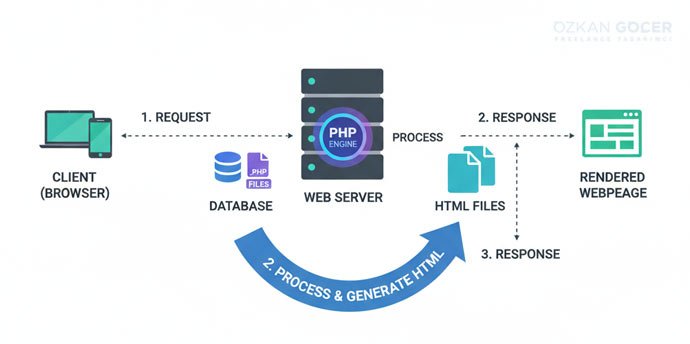
PHP runs on the server side, not on the user's device; this is its most important feature. When a visitor opens a page made with PHP, the request goes to the web server; the PHP code on the server runs (for example pulling data from a database, building the content) and sends the result to the visitor's browser as ready HTML.
So the visitor does not see the PHP code, only the generated HTML page. PHP runs in the background on the server, unlike JavaScript, which usually runs in the browser. To run PHP you need a web server (Apache or Nginx) and a PHP interpreter; developers set this up on their own computers with packages like XAMPP or WAMP. Running on the server side lets it do sensitive operations (database, password checks) in an environment hidden from the user and kept secure.
The Relationship Between PHP, HTML and WordPress
PHP and HTML work together but do different jobs. HTML is a markup language that defines the page's structure and content and cannot "think" on its own; PHP is a programming language that runs on the server and generates HTML dynamically. In practice, PHP code can be embedded inside HTML: most of the page is HTML, and the changing parts (a username, a product list, the date) are produced with PHP.
As for WordPress: the world's most popular content management system, WordPress, is written in PHP, and a very large part of the sites on the internet run on WordPress, and therefore on PHP. Many e-commerce and forum systems are PHP-based too. That range shows the practical value of knowing PHP: it opens the door to understanding and customizing these systems; it is the invisible engine of a large part of the web.
PHP's Advantages, Disadvantages and Current State
Like any language, PHP has strong and weak sides; but its current state is more alive than many think.
Advantages: it is relatively easy to learn and web-focused; because it is so common, there are plenty of resources, a community and job opportunities; almost every hosting supports PHP; and it works well with databases and the web. Disadvantages: it was criticized in the past for being messy (modern PHP has largely moved past this), security holes can appear if it is written carelessly, and in some modern areas JavaScript has come to the fore. Current state: despite "is PHP dead" debates, PHP is still very common and alive; the PHP 8 versions in particular modernized and sped up the language noticeably. Since WordPress and countless sites run on PHP, learning PHP is still a valuable, job-winning skill.
How Do You Learn PHP? Example Code
Learning PHP is a good start for those interested in web development. First learn HTML and basic CSS; then move to PHP basics (variables, conditions, loops, functions), learn form processing and working with a database, and build small projects. Later you can move to a framework like Laravel.
The simplest PHP example is printing text to the screen: when you write the PHP code <?php echo "Hello World"; ?>, the server processes it and shows "Hello World" on the page; the "echo" command outputs to the screen. To practice, you can set up a package like XAMPP on your computer and try things locally. For professional projects, a modern framework like Laravel is widely used. Resources include W3Schools, the php.net documentation and hands-on training sites. The most effective way is writing plenty of code rather than just watching; I compiled the features that make PHP popular in a separate article.
Other Meanings of PHP (Medicine and Currency)
The "PHP" abbreviation has different meanings in different fields, which sometimes causes confusion. In the programming context, it is the web development language that is the main topic of this article (PHP: Hypertext Preprocessor).
In the currency context, "PHP" is the international code for the Philippine Peso, the currency of the Philippines; in foreign-exchange and forex contexts, "PHP" means this. In the medical field, "PHP" can be used for various abbreviations depending on context (for example, in some contexts, "Partial Hospitalization Program"). So when you search "what is PHP", which field you mean matters: if you are talking about the web or software, it is the programming language in this article; if you are talking about currency, the Philippine Peso; if you see it in a medical text, it is a context-specific abbreviation. The article focuses on PHP the programming language, the most common search intent.