The crypto market has moved through several complete cycles: the 2017 bull run, the 2018 bear market, the 2020 DeFi summer, the 2021 NFT mania, the 2022 collapse, and the 2024 ETF approval. Most of the commentary around them was noise. My objective is to deliver a 2026-current, price-hype-free reference answering "what is Bitcoin?" without mixing it with general crypto assets, blockchain tech, or smart-contract platforms like Ethereum. If you need to grasp the foundational concepts first, read my what is cryptocurrency guide and the blockchain primer; the focus here remains strictly on BTC.
What Is Bitcoin? The Digital Gold Metaphor
Bitcoin is a financial network free from central bank, government, or corporate control. Thousands of independent computers globally verify every transaction on a public ledger called the blockchain. The digital gold comparison holds true because mathematical rules limit the supply to a scarce 21 million hard cap. Governments cannot print more of it.
Transactions know no borders, settling globally in minutes over the internet to preserve your purchasing power. Physical gold requires expensive vaults; storing Bitcoin costs nothing. You can divide 1 BTC into 100 million satoshis, and every transaction remains transparently verifiable. It works.
An important distinction exists in its utility. Bitcoin launched as a next-generation payment system, but 16 years of market evolution shifted its primary role to an inflation hedge in corporate treasuries. You probably will not buy coffee with BTC. Storing it for a 5-to-10-year horizon to preserve capital remains a highly coherent strategy, though you must do your own research as market volatility persists. Plan your timeline.
Satoshi Nakamoto: The White Paper and the Birth
On October 31, 2008, a person or group using the pseudonym "Satoshi Nakamoto" announced Bitcoin in a 9-page white paper. Miners generated the first block ("genesis block") on January 3, 2009, inscribing a headline from The Times: "Chancellor on brink of second bailout for banks," a symbolic protest against the 2008 financial crisis bailouts. Satoshi withdrew from the project at the end of 2010. He never resurfaced.
The creator's identity remains unknown, and the roughly 1 million BTC in Satoshi's wallets has sat untouched for 16 years. That dormancy is concrete evidence of an architecture where even the founder holds no control.
5 Features That Separate Bitcoin From "Cryptocurrency in General"
Investors routinely make the mistake of grouping all digital currencies together. Bitcoin differs fundamentally from the remaining 20,000+ crypto assets. Five specific technical and structural realities set BTC apart:
- A fixed supply cap: Code limits the total supply to 21 million BTC. Most alternative assets, including Ethereum, operate without a hard ceiling.
- Proof-of-Work consensus: Miners validate transactions using energy-intensive computation. Most modern altcoins run on Proof-of-Stake (PoS), which uses less energy but lacks decades of security testing.
- No smart contracts: The network focuses solely on moving value. Developers did not build it for decentralized applications (dApps), decentralized finance (DeFi), or non-fungible tokens (NFTs). Minimalist design protects the core monetary function.
- Anonymous/absent founder: No central authority, CEO, or foundation board controls the network. Most alternative coins rely on visible creators who influence development.
- Spot ETF approval (2024): The U.S. Securities and Exchange Commission (SEC) approved BTC spot exchange-traded funds (ETFs) in January 2024. Bitcoin became the first, and so far the only, crypto asset with a direct bridge to traditional finance.
Unique structural traits isolate Bitcoin into a distinct monetary asset class. Always do your own research (DYOR) before allocating capital. To explore alternative options, read my guide on the 6 popular cryptocurrencies you can buy and sell.
The 21 Million Cap and the Halving Cycle
Bitcoin controls its issuance rate through the halving mechanism. Every 210,000 blocks, which takes roughly 4 years to mine, the network cuts the block reward paid to miners by 50 percent:
- 2009: 50 BTC per block
- 2012 halving: 25 BTC
- 2016 halving: 12.5 BTC
- 2020 halving: 6.25 BTC
- 2024 halving (the most recent): 3.125 BTC
- 2028 halving: 1.5625 BTC (projected)
An asymptotic supply curve dictates this distribution, scheduling the final BTC minting for approximately 2140. Data shows BTC peaked 12 to 18 months after prior halvings. Do not treat past cycles as a guarantee. Macroeconomic realities change constantly. The halving triggers a programmatic supply shock, but external forces dictate the actual demand. Dollar liquidity, interest rates, and institutional capital flows move the price. Reading the cycle therefore means looking past the code and tracking global liquidity. I analyze these underlying market forces in why is Bitcoin rising: 5 fundamental factors.
The Spot ETF Approval: Institutional Money Arrived
Wall Street entered the crypto market on January 11, 2024, when the U.S. SEC approved 11 spot Bitcoin ETFs from issuers like BlackRock and Fidelity. Access to the asset changed overnight. You buy BTC directly on traditional exchanges like NASDAQ or NYSE just like any standard stock. No cold wallets, no seed phrases, and no exchange security risks. Data from tracking platforms like CoinGecko and CoinMarketCap showed over $50 billion in net inflows during the first year. The Andreessen Horowitz's State of Crypto report labels the milestone as the moment crypto started belonging to Wall Street.
To understand the institutional perspective, read the Harvard Business Review's corporate treasurer's guide to Bitcoin. MicroStrategy, Tesla, Square, and dozens of publicly listed companies hold BTC on their balance sheets. The corporate adoption rate continues to climb through 2026.
Bitcoin Mining: The 2026 Reality
Miners secure the Bitcoin network with specialized ASIC hardware (chips optimized for the SHA-256 algorithm), validating blocks and earning BTC rewards alongside transaction fees. Profitability dropped following the 2024 halving, forcing older, inefficient machines off the grid. Yet, the network's hash rate (total compute power) reached an all-time high in early 2026. Security has peaked.
Environmental critics point to heavy energy consumption, a valid concern. Clean energy adoption changes the equation, as 2024 sector analyses show more than 55% of the hash rate runs on renewable or otherwise wasted energy (such as gas flaring and surplus hydro). Sustainable practices gain ground annually. Labeling the industry entirely green is premature, but the transition is real.
How to Buy Bitcoin: The Practical Path
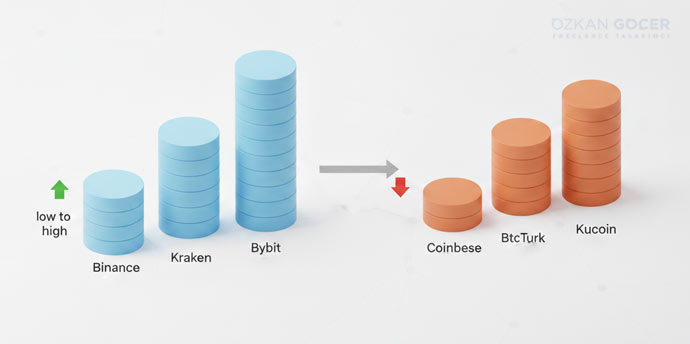
You can buy Bitcoin using three primary routes: centralized exchanges (CEX) such as Binance, Coinbase, Kraken, or BtcTurk; decentralized exchanges (DEX) like Uniswap or dYdX, which offer limited BTC support; or spot ETFs through a traditional brokerage account. Stick to licensed, regulated platforms when selecting a local exchange. One rule outweighs the rest: do not leave it on the exchange; transfer your BTC to a private wallet immediately. Learn how to set up your custody with my crypto wallet creation guide, and explore long-term storage options in my review of cold wallet models.
Risk and Custody: The Section You Cannot Skip
Far more people lose access to their coins through poor backup habits than through external hacks. Securing BTC in your wallet shifts the entire security burden to you. Protect your access. Implement three strict protocols immediately:
- Never store your seed phrase digitally: delete any photos, screenshots, cloud notes, or emails containing these words. Use physical backups like a metal plate or paper distributed across separate secure locations.
- For positions above $10,000, a cold wallet (Ledger, Trezor) is not optional; it is required. Keeping substantial capital in hot, internet-connected software wallets invites unnecessary risk.
- Understand the volatility: BTC price swings can reach 15-20% within twenty-four hours. Keep your short-term living expenses in fiat; do not allocate those funds here.
Three Things Bitcoin Is NOT
Bitcoin is not Ethereum: Ethereum functions as a smart-contract platform hosting DeFi, NFTs, and dApps. BTC serves strictly as a monetary asset. Separating utility from money prevents costly mistakes. Read my Ethereum guide to compare their mechanics directly.
Bitcoin is not "altcoins": Market participants classify every cryptocurrency other than BTC as an altcoin. Most alternative assets carry high risk and operate as experiments. Do not assume the "digital gold" properties of BTC apply to alternative tokens; they rarely do.
Bitcoin is not "blockchain technology": BTC represents a single, specific application of a distributed ledger. Blockchain operates as a foundational architecture with thousands of distinct use cases outside of currency. To understand the technical differences, read my blockchain primer.
My Personal Position for 2026
Extreme caution belongs in any crypto allocation, and you should do your own research. I hold Bitcoin strictly as a spot position forming a minor share of my assets, accumulated through dollar-cost averaging (DCA). Historical data shows strong performance 12 to 18 months post-halving, yet the 2026 cycle remains unpredictable. Institutional ETF flows now establish a price floor: a structural support absent in 2017 and 2021. Tightening macro liquidity remains my main threat because BTC drops when global liquidity shrinks. I never buy on margin or debt. Painful losses taught me that.
If you are launching a crypto product and require AEO or blockchain marketing consulting, or seek strategic direction for a Web3 project, you can send a brief using the form in the bottom-right corner. The intake takes three short steps. I will reply within 24 hours.