How the For You Feed Actually Ranks
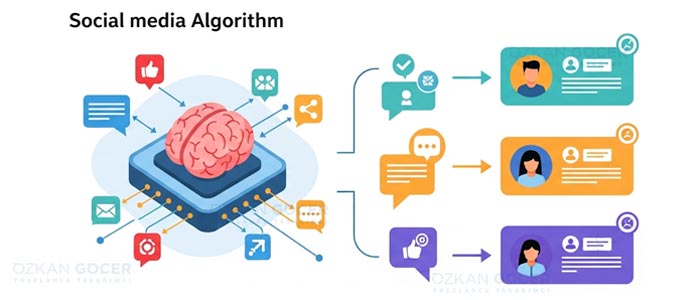
By TikTok's official explanation, the recommendation system looks at three families of signals: user interactions (likes, shares, comments, follows), video information (caption, sound, hashtags) and device plus account settings (language, country, device type). The third group carries the lowest weight. The weighting example in the same document is instructive: finishing a long video counts as a strong indicator, while the viewer and creator being in the same country is a weak one. The critical sentence is this: neither follower count nor an account's history of high-performing videos is a direct factor in the recommendation system. The system scores the likelihood that a viewer will enjoy each video, ranks them high to low, then runs a similarity check before building the feed, which is why the same type of content does not appear back to back.
The practical conclusion is clear: work on growing the video, not the account. The decision is made per video. We compared how that differs from other feeds in our guide to how the social media algorithm works. One myth deserves correcting: the claim that TikTok first shows a new video to existing followers and widens distribution based on their response has no basis in any official source.
Completion Rate, Rewatches and Shares
Because TikTok's own strongest example is built on completion, the first metric to optimise is not total views but the proportion of the video watched. On the sharing side there is a notable trend: Socialinsider's study published in April 2026, covering two million videos and 214,000 profiles, found shares up 13 percent year over year while likes rose 9 percent and comments 3 percent. Shares outpacing the others makes designing for shareability the priority: a piece of information, a list or a warning someone would send to a friend. The second lever specific to TikTok is the rewatch; linking the last frame to the first, revealing the answer at the end, and fast list-style delivery all feed the loop. When measuring, read three numbers separately:
- Average watch time. Seconds watched per video.
- Percentage who watched it fully. The honest reading of completion rate.
- Traffic-source breakdown. For You, search, profile and following split out here, and a rising search share means your TikTok SEO is working.
Ignore threshold claims in circulation such as "distribution increases above 70 percent completion"; TikTok publishes no numeric completion threshold.
Video Length: Short Clips or Over a Minute?
Technically you can record up to 10 minutes in the app and upload far longer, with limits unlocking gradually by account. The real distinction becomes clear on the money side: by TikTok's Creator Rewards announcement, the program rewards only videos longer than one minute, and one of the four components of its reward formula is watch duration itself, alongside originality, search value and audience engagement. So the length decision is often a revenue decision rather than a distribution one. The trade-off should be visible: a longer video grows total watch time but lowers completion rate.
The right rule is topic-based, not template-based. If your topic finishes in 40 seconds, do not stretch it; if it needs 90 seconds, do not compress it into 30. Padding damages completion rate and the revenue metric at the same time. The healthiest method is publishing the same topic at two lengths and comparing total watch time against completion rate side by side.
TikTok as a Search Engine: How TikTok SEO Works
The feed is not the only traffic channel on TikTok. By data TikTok published on its business blog, two thirds of discovery on the platform happens through search capabilities. In the research cited there, 55 percent of people say they prefer video and social platforms over traditional search engines when researching products, and 91 percent of those persuaded to act by a TikTok search went on to take that action. Search traffic carries a different density of intent than the feed. In the feed people drift, while in search the search intent is stated outright.
Mechanically, what matters is that TikTok search reads text layers: spoken audio, on-screen text and the caption are evaluated together. If the video's content does not match its spoken narration, search visibility weakens. The issue here is not hashtags but whether the spoken and written text inside the video matches the search query. We covered the same logic on classic search in our guide to writing SEO-friendly articles; on TikTok that logic moves into the video's audio and text.
Structuring Content for Search: Where Keywords Go
Placement has three layers: the target phrase should be spoken aloud in the opening seconds, appear as on-screen text, and open the caption. Do not settle for a single video; producing a series of five to eight videos around one question builds topical authority at the profile level and makes the same account appear repeatedly in search results. There is a critical detail for Turkey: Turkish users mostly type TikTok searches in everyday spoken language, phrasings that mean "how is it done", "how much does it cost", "does it work". Derive keyword choice not from corporate terminology but from the way the question is actually asked, and adapt your keyword research approach to that language. One more technical nuance: search views have their own threshold in Creator Rewards, where a For You view counts at five seconds while a search view requires 30 seconds of watching. After publishing, type your own target query into TikTok search and note weekly where your video ranks.
The Opening Hook: TikTok's Own Data
The attention window is narrow and TikTok has measured it in its own advertising research. In the platform's Value of View analysis, 90 percent of ad recall impact is stated to form in the first six seconds. In the creative effectiveness study run with Lumen, showing the product on screen delivered a 65 percent lift in brand affinity and 25 percent in recall; the same study found that creative elements prompting people to read extend watch time, meaning on-screen text is a watch-time tool rather than decoration. On audio, research with Kantar found that for 88 percent of users sound is an inseparable part of the TikTok experience, so the silent-viewing reflex carried over from Instagram can work against you here. An honesty note is required: all these figures come from studies on advertising creative and should be read as directional rather than applied directly to organic content. Four hook patterns genuinely carry their weight:
- Result first. Show the outcome, then explain it.
- Reject a myth. Deny a widely held belief in the opening line.
- Name the number. State the promise outright.
- Start mid-scene. Cut the setup entirely.
Write the hook before you shoot, not in the edit.
Trending Sounds and the Business Account Music Trap
There is a trade-off most businesses notice too late. Popular tracks in TikTok's general sound library are licensed for personal use and that licence does not extend to commercial, promotional content. Businesses that switch to a commercial account see the Commercial Music Library in the editor, containing over a million pre-licensed tracks. The result is this: while gaining the analytics and conversion tools of a commercial account, you lose access to a significant share of popular trending sounds. It should not be stated in absolute terms, since you can upload your own original audio and tracks in the Commercial Music Library can also trend.
In the Turkish context the trade-off bites harder: Turkish trending sounds and local songs mostly live in the general library rather than the commercial one. Using an unlicensed trending sound in promotional content risks the video being muted, removed, or action at the account level. In brand content the safest route is your own audio, a voiceover, or a track from the commercial library.
TikTok Shop Is Not Available in Turkey: What Sellers Should Do
For businesses in Turkey this is the defining constraint. Turkey does not appear in the shopping features list in TikTok's own business help centre, and the European expansion in mid-2026 did not include Turkey either. The practical consequence is that there is no in-platform selling and no sales attribution, so the funnel must be built outside TikTok.
The arrangement that works looks like this: content on TikTok, conversion on your own site or marketplace store. Point the profile link at a single clear destination and say out loud in the video where to go. Because there is no in-platform attribution data, UTM-tagged links and a TikTok-specific coupon code are essential; without them you will never know which video produced a sale. If you have no infrastructure of your own, invest there first, because traffic without a place to sell produces no revenue. We compared a marketplace store against your own site in our guide to entering e-commerce. One small task for today: tag the profile link with UTM parameters and define a single coupon code.
Creator Rewards and the Real Revenue Channels in Turkey
The advice often seen in guides, "make videos over a minute and TikTok will pay you", is not safe for Turkey. The eligible-country list for the Creator Rewards Program is not published on TikTok's accessible official pages, and Turkey does not appear on any reachable list, so planning on the assumption that the program is open in Turkey would be wrong. What can be said without absolute language is this: check eligibility in the Creator tools section of your own account, since country coverage changes over time. The reason to produce content over a minute in Turkey should be watch time and topical depth, not revenue. The channels genuinely open in Turkey are live gifts, brand collaborations and selling your own product or service. We detailed the growth logic on the collaboration side in our guide on becoming an influencer; on TikTok, bargaining power comes from consistency of views and clarity of niche rather than follower count.
The Shadowban Myth and For You Eligibility Standards
When reach drops, the first explanation people reach for is a shadowban, yet the framework TikTok publishes describes something different. The platform's For You feed eligibility standards state plainly that some content is not carried in the recommendation feed even when it does not violate community guidelines; the listed categories include potentially misleading health claims, extremely risky behaviour, low-quality or spammy content, and age-sensitive topics such as tobacco and alcohol. In other words, what feels like being banned is often not a penalty but a video judged ineligible for recommendation. The second reason is more mundane: because distribution is per video, one video's weak performance does not directly punish the next, and fluctuation is normal system behaviour. If you suspect an actual enforcement action, check your account status notifications; you can read how the system works in TikTok's transparency centre. Reading the eligibility standards instead of believing the myth lets you see the problem you can actually fix.
The TikTok Audience in Turkey: Who and How Many?
Making content decisions without audience data is hard. By DataReportal's Digital 2026 Turkey report, the number of TikTok users aged 18 and over in Turkey is 44.9 million, roughly 68 percent of the adult population and around 58 percent of internet users, with annual growth reported at 5.8 million people. The most distinctive figure is the gender split: about 59 percent of users are men and 41 percent women. That distribution shows that general advice assuming TikTok is a female-skewed platform may not hold in Turkey, and it directly affects product and content choices.
A methodology caveat is essential: these figures derive from advertising reach estimates rather than a count of individuals, so read them as an indication of scale rather than exact truth. Verify the real profile of your own audience from the follower demographics in your analytics.
Posting Frequency: More Posts Does Not Mean More Reach
Because distribution is per video, the expectation that "three videos a day will make the algorithm love you" is built on a misunderstanding. Since the system evaluates the video rather than the account, producing many videos with low completion rates does not grow reach; it only increases the production burden. The healthy approach is choosing a sustainable pace and improving the hook and completion on every video.
The real benefit of frequency lies elsewhere: more attempts let you learn faster which topic and which hook lands. If you are publishing to learn, change one variable per video, otherwise you cannot separate what worked. Running the plan with a social media content calendar is the most practical way to hold the pace. A frequency at which you cannot maintain quality will exhaust you and lower your average performance. Timing is not sacred either. If you still want a starting point for when your audience is awake, the data in our guide to the best times to post on social media is a reasonable first pass.
TikTok Business Accounts and Advertising
Serious business use requires a Business account, since analytics, scheduling and advertising tools are only available there. Advertising is open in Turkey: TikTok Ads Manager can be used and the ad account can be opened in Turkish lira. There is a common and irreversible mistake here: currency, region and time zone cannot be changed after the account is created, so set them up carefully.
Building organic and paid together is the most efficient route: promoting a video that already worked organically is both cheaper and more accurate than producing ad creative from scratch. We covered the performance logic on the Meta side in our Meta ads guide; the core principle holds on TikTok too, with creative variety mattering more than targeting. Do not start advertising before your organic base is in place, because a user who clicks and finds an empty profile will not convert. Run one experiment this week: publish the same topic as a 40-second cut and a 90-second cut, then set completion rate beside total watch time after seven days. Let the data decide.