“Alex is 35, likes coffee and uses social media” fills a slide without explaining why Alex never requests a quote. “They worry that switching systems will interrupt the business and want a migration plan with named responsibilities” gives a team something to investigate. A persona should make such decisions clearer, rather than decorate a fictional biography.
Buyer Persona vs Target Audience, ICP and User Persona
A buyer persona is not a personal dossier about one customer. It summarizes relevant patterns across people. HubSpot's explanation emphasizes profiles informed by customer research and existing evidence. If the profile is only a starting assumption, label it accordingly instead of presenting it as a research finding.
Scroll sideways to read every column. Keyboard: focus the table and use the arrow keys.
| Concept | Question | Example |
|---|---|---|
| Target audience | Whom do we broadly want to reach? | Small businesses that need a new website |
| Ideal customer profile / ICP | Especially in B2B, which organizations fit the offer? | Businesses whose scope, technical needs and budget match the service |
| Buyer persona | What does a person consider when deciding to buy? | An owner assessing migration risk and maintenance responsibilities |
| User persona | What needs and obstacles arise when using the product? | An employee who needs to update product information without technical help |
The buyer and user may be the same person, but do not assume that. An employee may use a tool, a manager may evaluate it and another person may approve the budget. An ICP exercise helps assess organization-level fit; it cannot answer every person-level question.
Decide What the Persona Will Help You Do
“Understand our customers better” is broad. Start with a decision such as “which questions should the website proposal page answer?” The same person's accounting-software purchase and holiday plans involve different circumstances. One profile does not automatically transfer between them. Nielsen Norman Group's discussion of persona scope connects the depth of research to the decision the profile should inform.
Record the product or service, market, research question, owner and review date. This makes it easier to connect the profile with objectives and channel choices in a digital marketing plan. Producing a persona does not itself guarantee sales, cheaper advertising or higher conversion rates.
How to Create a Buyer Persona
1. Gather Existing Evidence and Keep Its Sources Distinct
Start with proposal notes in your CRM, support questions, appropriately collected surveys, customer interviews and reasons for lost deals. Include people who did not buy or chose another solution, rather than only your happiest customers. A salesperson's interpretation and a customer's own words should be recorded as different kinds of evidence.
Search Console queries provide aggregate information about searches that exposed your site. They do not reveal each person's budget or full motivation. The Search Console performance report omits some queries for privacy. GA4 describes measurable on-site behavior, but a page exit alone does not explain why someone left. Use reports to develop interview questions rather than infer a complete biography.
Retain only information needed for the research. Participant codes, cleaned quotations and restricted access make working notes easier to share responsibly. Do not send identifying personal information to analytics; Google Analytics' rules on personally identifiable information are relevant here.
2. Discuss a Recent Decision That Actually Happened
“Would you buy a product like this?” can invite optimistic guesses. Ask someone to describe a recent event instead. User-interview guidance recommends open questions and follow-ups that uncover the details. Keep the conversation separate from a sales pitch, and avoid putting the answer you want into the question.
- What happened just before you started looking for a solution?
- How had you handled the task before then?
- Where did you first look, and what words did you search for?
- Which options did you compare, and why did you rule one out?
- Whom did you consult, or whose approval did you need?
- What missing information made you pause?
- After buying, what differed from what you expected?
Follow an answer with “can you tell me more?” or “what did you do then?” Reported behavior can differ from actual behavior. Where appropriate, compare interviews with authorized records and observed usage problems.
3. Group Needs and Obstacles Before Demographics
People of the same age can buy for different reasons; people of different ages can face the same obstacle. Group notes by the event that starts the search, the job to accomplish, evaluation criteria, objections and decision role. Include age, job title or company size when they explain the decision, not simply because a template has an empty box.
Attach sources and counterexamples to each finding. “Two of three interviewees asked about migration” is an observation. “All customers fear migration” is a much broader claim. Those numbers illustrate the method; they are not findings from a study conducted for this article. A small interview group should not be reported as a market-wide percentage.
4. Separate Evidence from Assumptions in the Template
Copy this template into a document or spreadsheet. Leave an unknown field marked “to investigate” instead of inventing a detail. A profile can remain short while linking back to the working evidence.
Scroll sideways to read every column. Keyboard: focus the table and use the arrow keys.
| Field | What to Record |
|---|---|
| Profile name and scope | A short label for the decision need; product, market and period |
| Role | User, researcher, influencer or approver |
| Job to accomplish | The desired outcome in the participant's own words |
| Trigger | A new need, a problem with the current solution or changed circumstances |
| Current alternative | What they use today, including doing nothing |
| Decision criteria | Scope, compatibility, cost, support or migration requirements |
| Obstacle and missing information | What stops progress and what evidence is requested |
| Information sources | Channels and search wording supported by interviews or records |
| Evidence | Participant code or record link, date and limits of the finding |
| Assumption and counterexample | An unverified interpretation and an observation that does not fit |
| Application | The content, offer or explanation to change |
| Validation and owner | How to check the decision, who follows up and when |
5. Test the Profile Through a Decision and Revise It
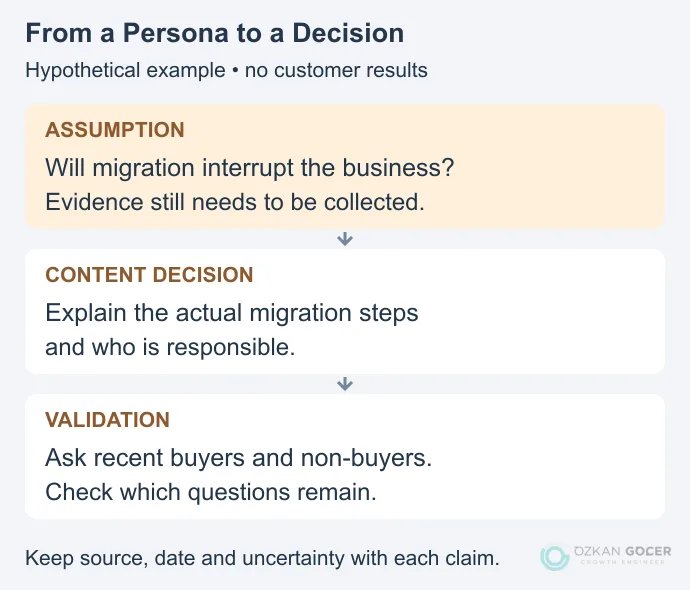
If the application field stays empty, the research may not yet connect to the work. Suppose migration uncertainty appears repeatedly. Add the actual transition steps, required customer inputs and responsibilities to the proposal page. Show it to relevant people and ask which questions remain. More clicks on a revised headline do not establish that the entire persona is valid.
If fresh interviews contradict the interpretation, revise the profile or investigate whether there are two distinct needs. A scheduled review helps, but changes in the product, pricing, market or objections may require attention sooner.
A Completed Example: A Business Planning a Website Rebuild
This profile is entirely hypothetical. It is not a real interview, customer quotation or commercial result. Its purpose is to show how a profile leads to a piece of work.
Scroll sideways to read every column. Keyboard: focus the table and use the arrow keys.
| Field | Example Entry |
|---|---|
| Profile | A business owner seeking a website rebuild without interrupting operations |
| Trigger | Being unable to update service information on the current website |
| Desired outcome | Explain services accurately and manage updates more easily |
| Assumed obstacle | Uncertainty about the domain, email and existing pages during the move |
| Explanation needed | Content to migrate, access requirements, responsibilities and launch checks |
| Content decision | Add a migration-questions section describing the actual proposal scope |
| First validation | Interview people who recently rebuilt or postponed rebuilding to see whether this obstacle recurs |
No age or fictional monthly income is included because neither is needed to explain this example. A budget range may matter for another offer; support it with interviews or proposal records rather than guessing. B2B decisions can involve several people, but it is inaccurate to reduce all business purchases to logic and all consumer purchases to emotion.
Using Personas in Content, SEO and Advertising
Translate people's questions into a content plan and an appropriate format. Someone comparing options may need a criteria table. Someone carrying out a task may need steps. Someone worried about switching may need a process explanation. The same person does not need the same sales message at every stage.
For SEO, preserve meaningful queries already visible in Search Console and use keyword research to explore unanswered questions. Estimated search volume describes potential demand; persona research helps investigate the need behind it. Seeing a query does not identify the age or income of the person who entered it.
In advertising, a persona can inform a message and landing-page hypothesis. Its attributes do not necessarily exist as targeting options in Google Ads or another platform. Instead of automatically excluding an “expensive persona,” review actual enquiry fit, service capacity and the platform's available controls. Assess suitable enquiries and business records alongside clicks.
Negative Personas and AI: Keep the Limits Visible
A negative persona can describe a need your offer does not meet. For example, someone requiring an integration you do not provide falls outside that service's scope. It is less useful to label everyone with a small budget or many questions a bad customer. An unclear offer or inadequate support can create those same signals.
AI can help group authorized, de-identified notes or format the template. Ask for a source reference beside each inference, and reject invented quotations, earnings or customer histories. The distinction between research-based and assumption-based personas helps explain why a provisional profile should not carry the same confidence as a researched one.
Finish with three practical checks: Can you trace a claim to its source? Which decision makes this profile different from another? What will a colleague do differently tomorrow after reading it? If the last answer is unclear, revisit the research purpose and application rather than adding more decorative biography.