
Imagine a store that sells reusable water bottles. Instead of saying its products are excellent, it could show how a particular lid fits together, using that model’s care instructions. The customer learns something useful; the store demonstrates relevant knowledge. Publication is only part of the job. Someone must decide how people will find the resource and who will correct it when the product changes.
How Does Content Marketing Differ from Advertising and PR?
The Content Marketing Institute’s definition connects a specific audience, useful content and a business objective. A collection of blog posts or social updates does not automatically form a strategy. You should be able to explain whose question each piece answers.
Advertising pays to distribute a message, which can include promoting a useful guide. Content marketing and advertising can therefore work together. Public relations addresses stakeholder communication and reputation more broadly. An original study might support both an editorial plan and PR outreach, although publication by an independent newsroom is never guaranteed.
Digital content marketing uses channels such as websites, video platforms and email. A printed magazine can serve the same purpose offline. Digital marketing is the wider category, covering content alongside advertising, search and other channels.
Which Content Format Fits the Question?
Choose the format that makes the explanation easier to understand. Video can show how a part moves; a table can make options easier to compare. You do not need to turn every topic into every possible format.
Scroll sideways to read every column. Keyboard: focus the table and use the arrow keys.
| Reader’s need | Useful format | What it should accomplish |
|---|---|---|
| Complete a task | Step-by-step guide, with a short video when needed | Make the action visible and explain critical steps |
| Choose between options | Comparison with explicit criteria | Explain which option suits which circumstances |
| Follow changes in a subject | Email newsletter or recurring audio program | Explain developments in context and distinguish outdated information |
| Check a claim | Research, table or infographic with sources and methods | Make the reasoning and evidence inspectable |
A real publishing example is John Deere’s The Furrow magazine. It describes its purpose as providing stories and practical knowledge farmers can use in their work. The useful lesson is to cover the audience’s working life rather than extend a product catalog. The magazine’s existence does not establish a sales forecast for another business.
How to Build a Content Marketing Strategy
Prepare a short decision brief before a publishing calendar. “Three articles a week” is an output target, not an explanation of the problem you will solve. Start with one audience, one real question and an answer you are equipped to provide.
Find the Question and Understand the Intent
Review support requests, recurring sales questions and your site’s Search Console queries together. Use keyword research to explore questions for which your site has little visibility. Estimated search volume alone cannot tell you how valuable a question is to your customers.
Look at the types of results and related questions: does the person want a definition, instructions or a product comparison? After identifying the search intent, check whether your site already has a page serving it. Improving an incomplete section may be more useful than creating another URL for essentially the same answer.
Complete a One-Page Content Brief
The bottle store is a hypothetical planning example, not a client case study. Narrowing the subject to one model’s lid makes the brief concrete:
- Reader and question: A new owner wants to fit the lid correctly.
- Evidence: Use current instructions for that model and a demonstration with the actual product. Do not substitute another model’s procedure.
- Main resource: Combine a short explanation, numbered photographs and a video showing the movement.
- Next step: Let the reader check compatible parts or contact support if the problem continues.
- Distribution: Make the guide discoverable in search, share a short demonstration on the relevant social account and link to it in an appropriate customer newsletter.
- Responsibility and review: Name the owner, schedule a review and check the content whenever the product changes.
- Success question: Are relevant customers reaching the guide, and are repeated lid questions declining in support records? Account for other changes in sales and support conditions.
Before publishing, ask someone unfamiliar with the task to read the first version. Find out what they still need to look up elsewhere. Add a screenshot or photograph when it explains a missing step; a stock image between every paragraph is unnecessary.
How to Distribute and Repurpose Content
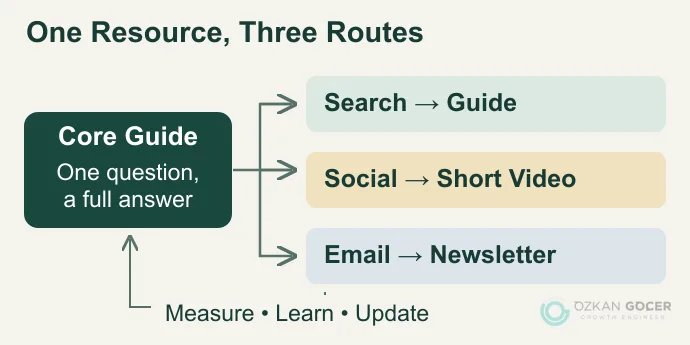
Adapt the useful part for each channel instead of copying the entire guide everywhere. A search visitor may want the full answer. Someone in a social feed may first need to see the movement. A newsletter subscriber can receive a brief explanation of the problem solved and a link to the relevant section.
Choose social media channels according to where your audience actually spends time. If you work with a creator, consider subject expertise and audience fit alongside follower count. From the creator’s perspective, choosing a focus as an influencer helps explain why that fit matters. Be transparent about gifts and paid collaborations.
For email marketing, match the topic and frequency to subscribers’ expectations. Consistent source, medium and campaign tags on links distributed outside your website can help distinguish incoming campaign traffic. Google’s UTM guidance explains how those values appear in reports. Do not add campaign tracking tags to your ordinary internal links.
How Does Content Marketing Support SEO?
SEO helps people discover content through relevant searches. Content marketing also determines what information to produce, who needs it and how it serves the business. Repeating variations of a keyword cannot repair an incomplete answer.
The title, H1, description and opening should make the same promise, and the body should deliver it. Give a definition seeker the answer early; follow with examples, evidence and practical detail. The guide to writing an SEO-friendly article explains the editorial checks in more detail. Link naturally to useful related subjects instead of sending every paragraph toward a sales page.
The page also needs to be crawlable, use an appropriate canonical and work on mobile. Better writing alone cannot resolve access or indexing problems; review those through technical SEO checks. Google’s helpful-content questions provide a useful final review of original value and whether readers can finish their task. Neither strong content nor correct technical settings guarantee a particular ranking.
How to Measure the Results
Record the objective and comparison period before publishing. Total visits can rise because of unrelated traffic, so they should not be the only success measure. Read the following indicators together:
Scroll sideways to read every column. Keyboard: focus the table and use the arrow keys.
| Objective | Indicator | What it cannot establish alone |
|---|---|---|
| Reach relevant searchers | Impressions, clicks and click-through rate for relevant queries | An impression does not mean someone visited the page. |
| Resolve a question | Feedback, task completion checks and related support requests | A long reading session does not necessarily mean understanding. |
| Support a business objective | Defined outcomes such as a suitable inquiry, trial, registration or purchase | A simultaneous increase does not prove that content alone caused it. |
In GA4, verify that the relevant interaction is recorded correctly as an event, then mark the appropriate event as a key event. The tool cannot choose your business objective for you. Consent choices, different devices and your measurement setup can leave gaps in the reported journey. Check that tracking works soon after launch; judge outcomes over a period suited to the audience’s decision process and the amount of data available.
What Does Content Marketing Cost?
Compare more than word counts in a proposal. Research, expert input, writing, original photography or video, editing, translation and distribution require different skills and time. In-house work has a cost too. Publication is not the final expense: changes to a product, source or interface can require an update.
For planning, multiply production hours by the relevant hourly cost, then add external services, allocated tool costs, paid distribution and expected maintenance. Avoid counting the same work as both an internal expense and an outsourced service. Define the scope, deliverables and maintenance owner instead of assuming one price or a three-month result applies to every business. A page remaining online does not guarantee free traffic.
Can You Use AI for Content Marketing?
AI can help group questions, outline a draft or adapt verified information into another format. It should not pretend to have used a product, invent customer experiences or supply unchecked statistics. The workflow still needs a person responsible for checking the final text, links and claims made in images.
Google’s guidance on AI-generated content focuses on quality and purpose; using automation to manipulate rankings can violate spam policies. Start with a question you can answer well. If you already have a useful resource, improve its gaps before making another page, then put its distribution and review plan to work.