What Each Option Actually Is
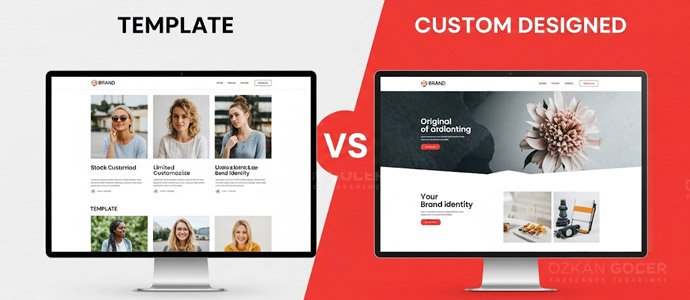
Separating the two approaches clearly is half of the right decision. With one you build on a ready-made frame, with the other you build everything from scratch.
Website builders (Wix, Squarespace, Webflow)
A builder site is one you assemble on a website builder (for example Wix or Squarespace) or a ready theme, using drag-and-drop tools and very little code. You take a ready frame and template, place your content, and launch quickly. More flexible platforms like Webflow also broadly fall into this category.
Custom design and development
Custom design is a site designed and coded from scratch for your brand and business goals, without a ready template. Every component is built to need; that means more uniqueness and flexibility, at the cost of higher price and time. I explain the basics in my what is web design article.
Side-by-Side Comparison
Let us put the two approaches next to each other on the core criteria:
Scroll sideways to read every column. Keyboard: focus the table and use the arrow keys.
| Criterion | Builder | Custom Design |
|---|---|---|
| Upfront cost | Low, monthly subscription | High, then drops |
| Setup time | Days | Weeks |
| Uniqueness | Limited by template | Full, brand-specific |
| Scalability | Limited at some point | High |
| SEO and performance control | Limited | Full control |
Cost, time, control, scalability, SEO
The table sums it up: a builder wins on speed and low upfront cost, while custom design pulls ahead on uniqueness, scale, and control. Which matters more depends on your business's need today and its growth plan tomorrow; meeting a standard need fast is a different choice from wanting full long-term ownership.
Decision Matrix: Which Wins for You?
If your budget is tight, your needs are standard, and you want to launch fast, a builder makes sense: a small-business brochure site, a personal portfolio, or a simple service page fit here. If branding, unique functionality, scaling, and long-term ownership are priorities, custom is the better fit: growing e-commerce, apps with custom flows, and investor-facing corporate sites lean custom. I gathered the steps to build a site from scratch in my how to build a website article.
Ownership and Lock-In: Can You Migrate Later?
A builder's low upfront cost is appealing, but it has unseen costs. The monthly subscription adds up over time, uniqueness is limited by the template, and you blend in with thousands of sites using the same theme. The biggest risk is platform lock-in: when your business grows and hits the builder's limits, migrating elsewhere gets hard, because even when content can be exported (to a system like WordPress), the design and platform-specific features often have to be rebuilt. If you plan to scale, factor that lock-in in upfront.
SEO and Performance: Is Custom Really Better?
Custom design is not automatically better for SEO; a well-built builder site can be perfectly SEO-friendly. The real difference is that custom gives you full control over technical SEO and performance: you can optimize page speed, code structure, and Core Web Vitals to the limit. A poorly coded custom site can underperform a well-built builder site, so what decides it is the quality of the work, not the platform. I cover the conversion side in my conversion article.
Realistic Cost and Total Cost of Ownership
Let us be realistic: with a builder you can launch for a low cost starting at a few dollars a month, while custom design needs a noticeably higher upfront budget depending on scope. What matters is not just the upfront cost but the total cost of ownership over a few years: the builder's subscription accumulates, while the custom site's high start can become cheaper long-term by removing platform limits and rework. I compared web costs in detail in my website prices article; the right question is not "which is cheaper" but "which brings me more business value."
If you want a conversion-focused, fast, SEO-friendly site, you can take a look at the web design services I offer.